|
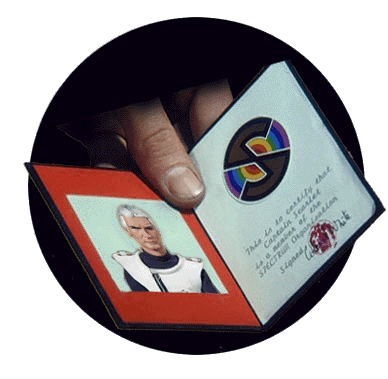
Spectrum
designation:
|
Colonel
White
|
|
|
Rank
and attributions:
|
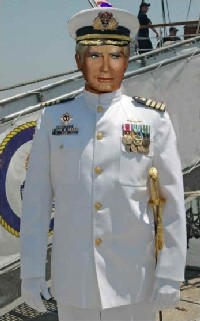
Commander-in-chief
of Spectrum, commander of Cloudbase Spectrum HQ
|
|
Real
name :
|
Charles
Gray
|
|
Place
of birth :
|
London,
England, United Kingdom
|
|
Date
of birth:
|
14
July 2017
|
|
Height:
|
6
Ft. 1 Ins.
|
|
Weight:
|
172
lbs
|
|
Eyes:
|
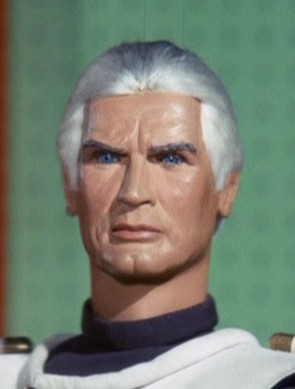
Blue
|
|
Hair:
|
White/grey
|
|
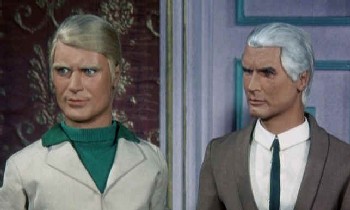
Puppet
specifications:
|
Facial
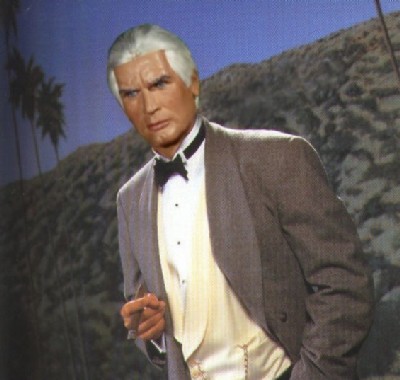
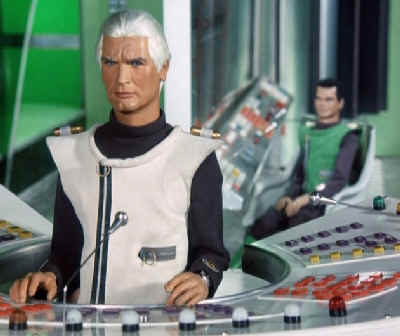
characteristic and voice of Colonel White were based on actor
Donald Gray, who provided the voice.
|
Personal
history
Born
in London, England, and growing up under Britain's Military Regime, Charles Gray studied at King’s College,
Canterbury, Kent, a private
school, until the age of 17, and then moved to a branch of
the Norwich Military College of Vermont based at the University of
East Anglia in Norfolk. In
2038, at the age of 21, he gained first class honours in degrees for
computer control, navigation and technology.
When he left university, he put his hard-won qualifications
to use by enlisting with the British Navy, and served on submarines
and destroyers, in various hot spots of the time – such as South
East Asia in 2040, the Iceland dispute in 2042, and the
Panama-Isthmus rebellion of 2042-43.
In
a remarkably short time, Charles Gray rose through the ranks to
become Captain in 2046, at the age of 29.
The same year, in December, the British civil war erupted. At the time he was the captain of an un-named British Navy
Destroyer in the Atlantic, and Charles Gray presumably went against
his superiors’ orders and sided with the rebels, heading back to
Britain to join them and help overthrow the military dictatorship
which then ruled Britain. The
rebellion was over in a matter of weeks, and Britain finally joined
the World Government in February of 2047.
Charles
was offered full command of a World Navy Destroyer by the World
Government, and his continuingly successful career eventually
culminated in his being made Admiral of the Fleet, at the very young
age of 30.
Often
in the headlines, Charles Gray became a public hero for his daring
escapades. His
coolness in tricky situations and extraordinary leadership qualities
had gained him the respect of top military staff all around the
world. For that reason his friends and military peers were taken by
surprise when, at the age of only thirty years old, he announced his
retirement from military service.
In
fact, this was a carefully prepared cover-story because Gray had
been selected to serve in the Universal Secret Service (the USS), as
a field agent. It was
around this time (2048) that he married.
After
two years of active service as a field agent, during which he
completed his various missions with success, Charles Gray was
promoted, in 2049, to reorganise the British section of the USS.
This is where he demonstrated the full extent of his innate
talents for leadership. In
2050, he was officially promoted to head of the British section of
the USS, receiving command of the London section of the World
Intelligence Network. This
division, which was in disarray due to infiltration by enemy agents,
was the disgrace of the entire USS.
Gray ruthlessly cleansed the London HQ of all enemy agents
and infiltrators within a year of his appointment, a seemingly
impossible task. Through
his ruthlessness in command, determination and tactics, Gray
successfully transformed the USS London section into a high
standard, efficient and smooth-running office.
It was also about that time that Charles became a widower
(date unspecified).
Because of his
dedication, his ability to obtain results and his astounding
leadership qualities, in 2065 Gray was offered the post of Supreme
Commander of the USS, but he rejected this in favour of accepting
the offer made to him by the Spectrum Selection committee.
This was the position of supreme Commander-in-Chief of the
new Spectrum security organization, and of its Cloudbase
Headquarters, as well as the rank and colour-codename of Colonel
White.
|
|
Personal
history’s inconsistencies…
As
with many – if not all the characters from the series, there are
various inconsistencies regarding Charles Gray/Colonel White’s
biography.
For
example, the 1967 annual says White joined the World Navy – with
no mention of the British Navy. It is also where the mention of the
Norwich University, a military college in Vermont appears. But, as
some of the previously published details of Charles Gray’s
biography didn’t coincide with what was later written in ‘Century
21’ magazine as an ‘historical background’ for the Gerry
Anderson series –most notably with the now infamous ‘Military
Regime of Britain which lasted from 2028 to 2047 – Colonel White’s
biography was rewritten and he became a hero of that period. That
later information is now regarded as ‘canon’.
It
would also seem unlikely that Charles Gray became a captain at 29
and then retired as Admiral of the Fleet at 30. He’d have had to
have been promoted 5 times in one year (using British Naval ranks).
But as those were ‘difficult times’ – especially for
Britain – it just
might be conceivable that the Military Dictatorship which Britain
was under, was in dire need of ‘heroic figures’ to use for
championing their probably unpopular regime.
Young and feisty officers, such at Gray, would likely have a meteroric career, if their exploits often became headlines.
That Gray would later turn against the Military Government
seems like an
interesting twist of fate.
As
for the World Government – perhaps they sought to handsomely
reward the man who had helped put down the Military Regime; as such,
it might have seemed like a sensible move to offer him the rank of
Admiral – especially if they recognised his expertise for the job.
In the event, he did not remain long in that post.
Granted, this might seem like a far-fetched explanation…
but so far, there is nothing better
to offer.
|
|
Personality
profile
His
dedication to his work and his sincerity have earned Charles Gray
the respect of his military peers around the world – a respect
that ‘Colonel White’ also receives from his fellow officers and
the crew of Cloudbase, as well as Spectrum’s ground bases
and its related global organisations.
Known for his often hot temper (as seen in “Avalanche”
and “White as Snow”), this respect might tend to waver at times,
however it is never completely lost.
He
frequently demonstrates that he knows the officers under his command
very well and will use their individual characters to achieve
success in their missions – such as when he engineers Captain
Scarlet’s dismissal for gambling in “Special Assignment”,
knowing full well that Captain Blue will track his partner down to
discover why Scarlet acted as he did.
Off
duty the Colonel is still engrossed to a great degree in his work,
finding little time to completely relax and forget his
responsibilities, even for a while.
When he does find a few minutes to himself he likes to
participate in role-playing ‘war-games’ along with Captain
Scarlet. He is also a ruthless chess player, and other spare moments
are taken up by gardening, and reading crime fiction.
He’s even started to write his own “whodunit”.
The
infamous ‘rose tree’ that the Colonel tends on Cloudbase
Promenade Deck in his dead wife’s memory, and that he forbids
anyone to touch, was never part of the official background – but was created
by Chris Bishop for her story ‘A Question of Trust’.
References to that rose tree crept into later stories, and
other authors have mentioned it.
|
|
Colonel
White and Spectrum...
Supreme
commander of Spectrum, and of its hovering headquarters, Cloudbase,
it would seem, according to various sources, including Century 21
magazines and annuals, that Colonel White, along with Captain Black,
was deeply involved with the creation of the security
organisation - which is stated to be the brainchild of Nikita
Bandranaik, the first World President. According to those
sources, the idea of Cloudbase would come from the former admiral -
actually originating from earlier plans of a submarine, then a
floating island, or even a carrier. It is also said that White was also
responsible for the rear-facing seats which the Spectrum
Pursuit Vehicles are equipped with.
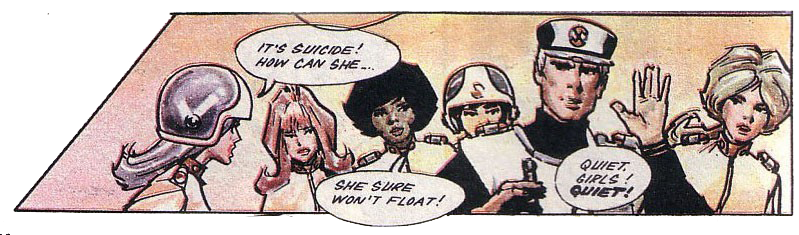
While
it can be suggested that White had a say in the selection of the
agents that would work the most closely with him, it is a documented
fact that he did, with Lieutenant Green, closely supervise
the training of the five girl pilots who would form the Angel
Squadron (as reported in the comic strip 'The Angels').
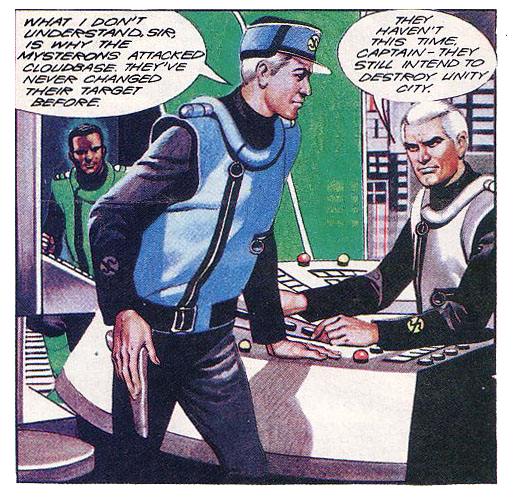
Colonel White certainly demonstrated a flair for the melodramatic
when he chose not to present himself directly to the Angels, but
instead left Lieutenant Green to make the first contact with them -
through a voice speaker, the pilots never actually seeing their
'mysterious boss'. There is no doubt that, if that voice was
Lieutenant Green's, it was Colonel White's instructions that were
conveyed to the Angels.

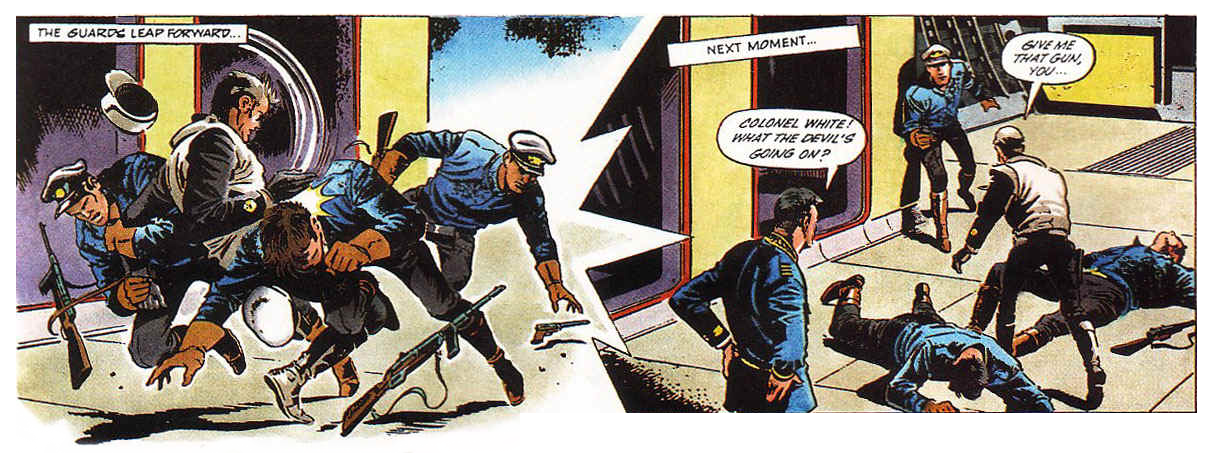
As
Spectrum high commander, Colonel White seldom participates in the
action, most of the time staying on Cloudbase to supervise the
operations from the Control Room. However, he can, and will,
put himself on the line when necessary, as demonstrated in
"White as Snow" and "Spectrum Strikes Back", and
various other events reported in strips published in Century 21
magazines.
Considering his background as
a Universal Secret
Service ground agent, we must believe that Colonel White is not
adverse to take action himself, if there is a need for it, and that
he is quite capable of handling any dangerous situation in which he
could find himself.
|
|
About
his family
Official
sources don’t list any family for Colonel White, except for his
deceased wife. Presumably,
he has no children, as might be indicated from the comments in the
John Theydon book “Captain Scarlet and the Mysterons” where it
is stated that the colonel “regarded the Angels as the daughters
his wife didn’t give him before her death”.
This statement might or might not be accepted as official,
but it can be taken as a general indication of Colonel White’s
background.
It’s
only within fan fiction, an unofficial source, that more detailed
information has been invented about the Colonel’s background.
In the story “Spectrum is White”, Chris Bishop called his
deceased wife Elizabeth Somners, formerly his partner within the
USS, who died while expecting their
first child, during a plane crash – which Gray survived.
In the same story, the name Alexander Gray was given to
Charles’ father – with the information that he was a drill
sergeant of the British army, and a helicopter pilot who died when
his craft crashed before his son’s eyes.
Also
worth noting is the
name ‘Annabel’, used for White’s wife – in a story written
by Marion Woods, and an 82 year old Professor of Mathematics, as his
father, created by Polly Amber for a few of her short, amusing
stories.
Chris
Bishop also suggested a relationship between Charles Gray and Amanda
Wainwright, an original character she created as the widowed mother
of Symphony Angel (Karen Wainwright).
While created for fanfic and definitively not official, the
relationship seems to have been accepted by many other writers for
their own stories (such as Marion Woods, Sage Harper and Lezli
Farrington), even to the extent of marrying the two of them in
stories based in the future.
 
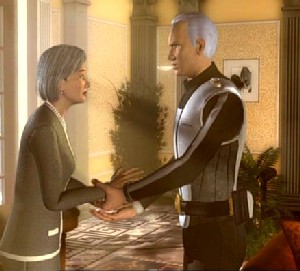
The
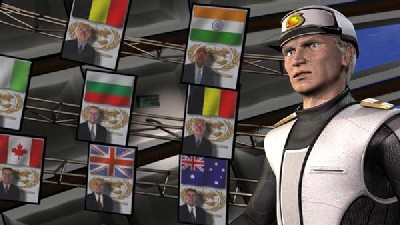
Colonel White character from the ‘New Captain Scarlet’ CGI
series has been given a more detailed and official family background
– with a wife, named Diana, and a daughter, Victoria. An
interesting point worth noting, the character is actually ‘Sir’
Charles Gray, a title the character doesn’t have in the original
series, but which was pre-empted by Chris Bishop’s story
“Spectrum is White”, in which it was given to the original
White.
The
CGI character, with his different background, while very similar to
the original one, should be considered as a distinct character.
|
The
many faces of… Charles
Gray
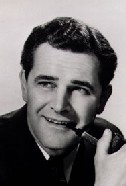
The
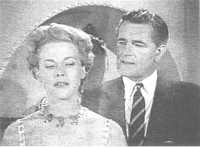
features of Colonel White were inspired by Donald Gray, the actor
who gave him his voice – as well provided the voice of Captain
Black and of the Mysterons, for which he used a deep, ominous tone.
DONALD
GRAY was born Eldred Donald Owermann Tidbury March 3, 1914, at Fort
Beufort. In 1933, he was the South African winner – then the all
world winner – of Paramount Pictures Search For Beauty.
He was contracted as a bit player until 1935 in Hollywood,
with countless minor roles as Elred Tidbury.
He then changed name to Donald Gray in 1936, after moving to
England.
|

Mark
Saber |
Gray
appeared in Rep and some minor roles in the cinema particularly in
"Strange Experiment" (1937) when he replaced James Mason
who had stormed off set. In 1938, he received a lead role as one of
the four officers in an Alexander Korda film "The Four
Feathers". He replaced Stewart Granger in Rep in “Aberdeen”
in 1939. Rejected from
the services due to duodenal ulcer, he re-enlisted as a Private in
the Gordon Highlanders and became an Officer in King’s Own
Scottish Borderers in 1941. He
lost his left arm in combat July 18, 1944.
After the War, he started his own Theatre Company in South
Africa, then went to the BBC, first in the ‘Radio Reparatory
Company’ and then as a Newsreader and announcer on BBC TV. He
played in the film “Island of Desire” (1952) as a lead with
Linda Darnel and Tab Hunter, and became more widely known in ITV’s
“Mark Saber” (1955-1960).
After
that, Gray became badly typecast, only landing roles in narration
and TV commercials - it was during this period that he was hired to
do voiceovers in “Captain Scarlet & the Mysterons”.
|

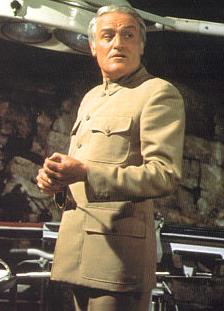
Actor
Charles Gray as Blofeld |
Gray’s
last film was “Murder on the Campus” (1962), directed by
Michael Winner. He landed some minor TV roles in 1970s: Paul Merton
in “Dixon of Dock Green”, Father Conrad in “Donati
Conspiracy”, Doctor Garnett in “Doctor in Charge”
and Paul Hogburn in “Emmerdale Farm”.
Married to Sheila Green (1955), he had two daughters Loretta
(born 1956) and Deborah (born 1959). Settled in Farnham in Surrey,
he died on holiday, at the age of 64 on April 7, 1978 of a coronary
in East London, South Africa.
It is interesting to note that
another actor named “Charles Gray” was a contemporary of Donald
Gray, an English-born actor whose real name was actually Donald
Marshall Gray! A character actor, Charles Gray specialised himself
at playing bad guys and despicable characters in many movies – he
became most notoriously known as the villainous Ernst Stavro Blofeld, James Bond’s arch enemy in “Diamonds are
Forever” – and director of the evil organization THE SPECTRE (a
name so curiously similar to SPECTRUM!).
|
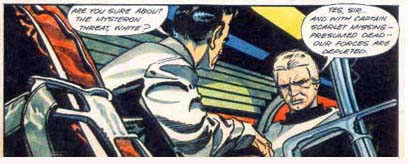
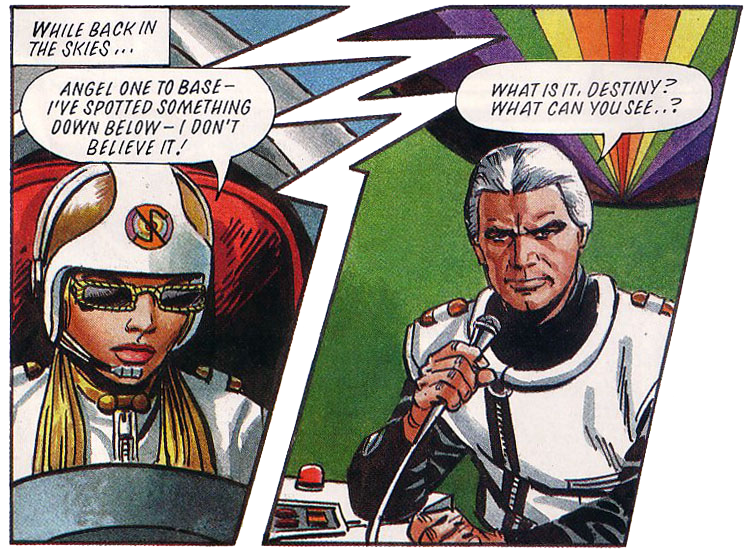
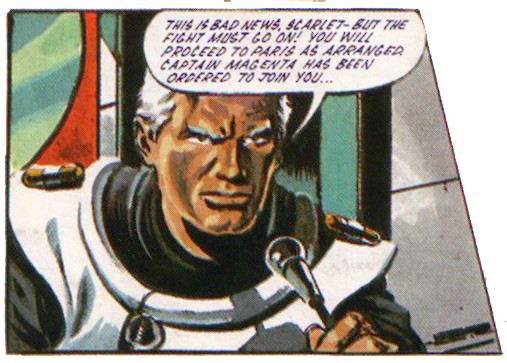
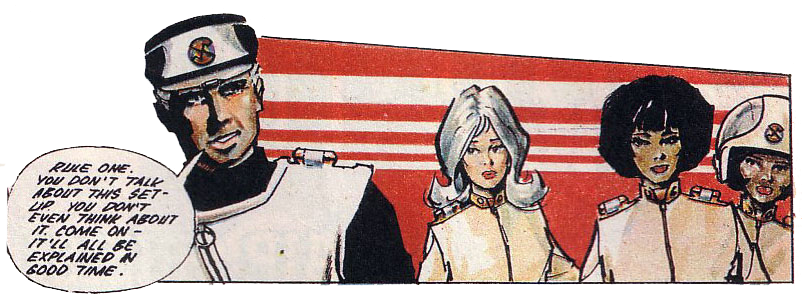
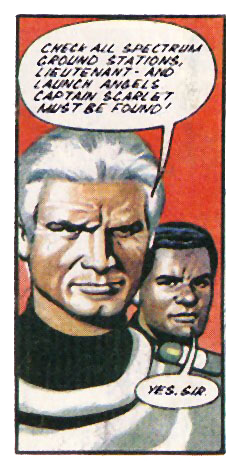
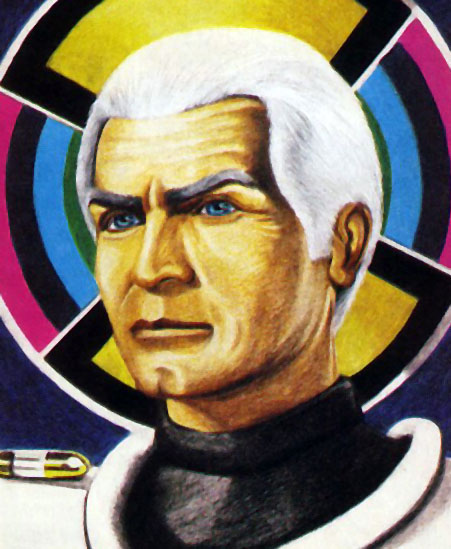
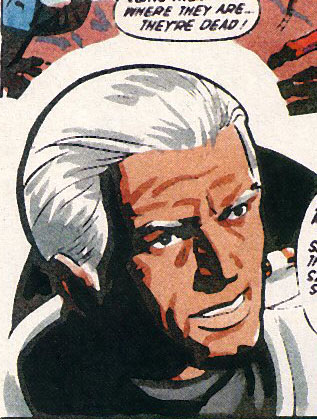
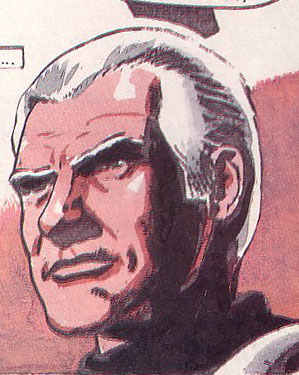
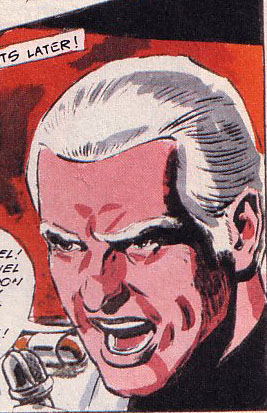
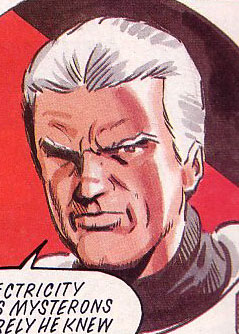
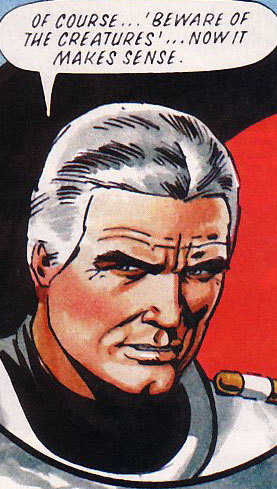
As
with the other characters of the 'Captain Scarlet and the
Mysterons' series, Colonel White was drawn by many artists,
notably for the comic strips that run in the pages of the various
magazine produced by Century 21, not only for the Captain Scarlet
strip, but also the Angels strip, in the Lady Penelope
magazine, where artist Jon
Davis
drew Colonel White's as he first appear to the girl
pilots.
|
|

Mike
Noble |
Ron
Embleton was first to draw Colonel White for the Captain Scarlet comic strip, and also included
the character in a
wonderful poster, along with Captain Scarlet himself, Captain Blue,
Lieutenant Green and Rhapsody Angel. Mike Noble, probably the
artist mostly renowned for the Captain Scarlet strip offered a
rendition of Colonel White that made him almost as much an action
man as the officers under his command. Other artists
followed in Mike Noble's footsteps for the comic strip (such at
Keith Watson, Don Harley, Frank Bellamy, John Cooper, Mike
White, etc.), and all of
them, consequently, had to draw the Spectrum commander. |

Ron
Embleton |
|

Keith
Watson
|
Don
Harley
|
Bellamy/Harley
|
John
Cooper
|
Mike
White
|
|
|
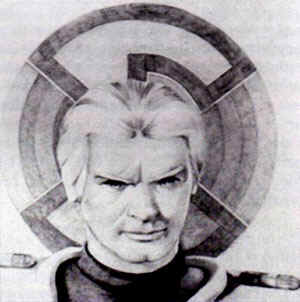
In the 80s, artist Lynn Simpson drew a series of
Spectrum portraits, featuring Captain Scarlet, Captain Blue,
Captain Ochre, Captain Black and Colonel White.
Years later, she drew another portrait of the Spectrum
commander, for one of the short-lived 'Captain Scarlet & the Mysterons' comics,
which were published between 1993 and 1994.
|
|
|

|
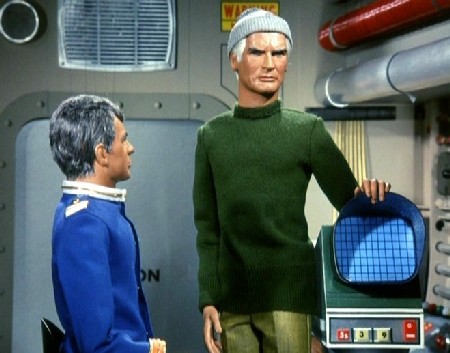
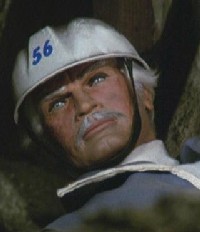
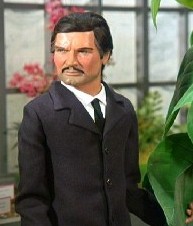
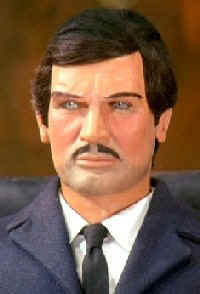
The Colonel White puppet appeared in 31 of the 32
episodes of the Captain Scarlet series (the only exception being
"The Inquisition"). The puppet was later used in an episode of the
“Joe 90” series to personify the father of Sam Loover, and for a
couple of shady characters (with darker hair) in "Secret
Service".
|

'To
catch a spy'
(Secret
Service) |

'See
you down there'
(Joe
90) |
|
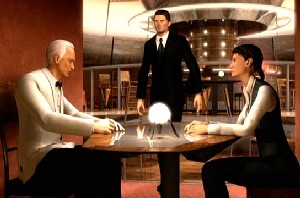
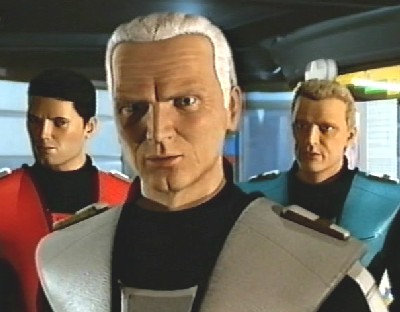
 The character of Colonel White, created for the CGI
series, is very much similar to the the character from the original
series in characteristic and personality. The features of the
CGI White were indeed based on those of the original puppet.
The background for each character, however, differs greatly, and it
would seem that for the CGI series, more thought was given to
that aspect of the character, with White now having a family - of
which he admits is his reason to continue the good fight. This
White seems closer to his officers, especially the female Lieutenant
Green, working so closely with him for years, and would freely call
them by their first names - something that was never heard from the
Colonel White of the Supermarionation show. However, another
trait shared between the two characters: neither of them
would hesitate to make the hard choice of sacrificing one of their
staff or give the order of attack, if it means saving the greater
number - as seen in "Manhunt" and "White as
Snow" (Supermarionation) and "Instrument of Destruction,
Part 2" (CGI).
|
|