|
Spectrum
designation:
|
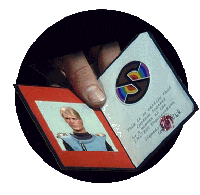
Captain
Blue
|
|
|
Rank
and attributions:
|
Senior
staff officer, colour-coded Captain. The usual partner
of Captain Scarlet
|
|
Real
name :
|
Adam
Svenson
|
|
Place
of birth :
|
Boston,
Massachusetts, U.S.A
|
|
Date
of birth:
|
26
August 2035
|
|
Height:
|
6
Ft. 3 Ins.
|

|
Weight:
|
196
lbs
|
|
Eyes:
|
Blue
|
|
Hair:
|
Blond
|
|
Puppet
specifications:
|
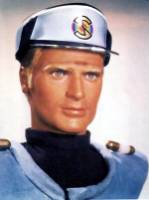
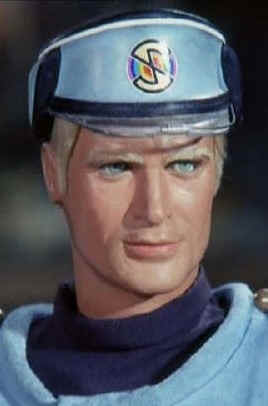
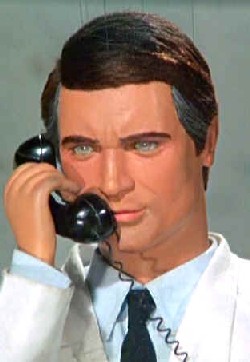
Captain
Blue’s facial characteristics were generally thought to be
based on Ed Bishop. In ‘The Complete Book of Captain
Scarlet’, by Chris Bentley (Carlton Books, 2001), Terry
Curtis, the sculptor who made the puppet, revealed that
Captain Blue was ’a kind of version of myself’, although
Sylvia Anderson had told him to base the puppet’s features
on a likeness of the actor who provided the voice - Ed
Bishop.
|
Personal
history
Adam
Svenson was born a year after the Atomic War of Europe, which lasted
from 2028 to 2034. The
eldest son of a wealthy family from Boston, his father was a
successful financier. The
family fortune ensured he had a first-rate education and Adam was
very successful at school; winning a full scholarship to the renown
Harvard University, in Cambridge, Massachusetts, at the early age of
16. Here he
gained first-class honours degrees in economics, technology, applied
mathematics, aerodynamics and computer control.
It seemed as if Adam was destined for a successful career in
the family business, but he disappointed his father by choosing a
very different career that appealed more to his yearning for an
exciting, action-packed lifestyle.
Adam
enrolled in the World Aeronautic Society in 2055, at the age of 20,
and whilst serving there received training in military-based
strategy and piloting skills, in order to become an aircraft test
pilot. Possessing courage and drive, Adam was acclaimed as a
fearless pilot. In 2057 his superiors at the WAS, observing his energy and
courage, believed that his inherent
qualities could be put to better use and transferred him from
the job of test pilot to that of an active field agent in the
security department. At
first dismayed by this change in his career, Adam soon realised the
challenges this new job provided.
The WAS’s security was persistently being compromised by
the infiltration of enemy agents, and saboteurs, so with the help of
twenty hand-picked officers, it was his job to take care of the
problem. He did so with
enthusiasm, determination and ruthlessness.
Hampered
by unseen forces, and always unsure if the people working alongside
him were double or triple agents working for the enemy, Adam
suffered many setbacks on the way to achieving his target. In his
first six months of joining the WAS security department,
three assassination attempts were made on his life by
Bereznian agents, but he finally succeeded in bringing the reign of
sabotage and spy infiltration to an end, proving his ability to get
results despite the odds against him.
Adam
Svenson’s success at the WAS, as well as his strong personality
and vitality, brought him to the attention of the Spectrum selection
committee in 2065, and he was amongst the first men to be approached
with the offer of the rank and colour code of Captain Blue – a new
challenge that Adam accepted.
Trustworthy,
perseverant and loyal to a fault, Captain Blue is the ideal Spectrum
officer. He
demonstrates an ability to work for Spectrum in many capacities and
has, when the situation demanded it, replaced Colonel White as the
commander of Cloudbase (‘White as Snow’) and Lieutenant Green as
Communication Officer (‘Avalanche’). It is Blue who is given the
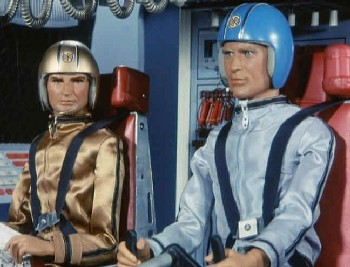
task of driving the eccentric lunar vehicles when Spectrum
investigates Mysteron threats on the Moon.
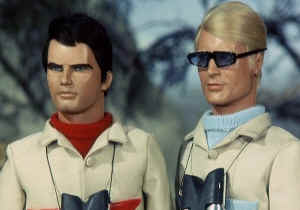
Blue
is the ideal field partner for Captain Scarlet and is also his best
friend. Although very
self-disciplined, Blue does sometimes display wilfulness, especially
in support of his friend (‘Special Assignment’, ‘Renegade
Rocket’). On duty, he
inspires those working alongside him; off duty, he retains his
forceful, sceptical, possibly over-confident personality (‘White
as Snow’), but has developed a seemingly endless patience with his
fellow officers.
Blue
loves outdoors activities, taking every opportunity to travel down
to the east-coast of Australia, where he enjoys water-skiing,
surfing and deep-sea fishing.
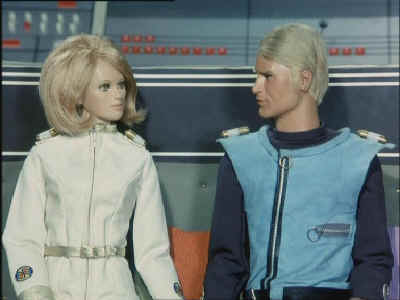
Captain
Blue appears to have romantic feelings for Karen Wainwright
(Symphony Angel), which he sometimes allows to cloud his judgment. These feelings are obviously reciprocated by Symphony.
About
Symphony Angel
If
there could be said to be ‘evidence’ of a relationship between
any of the major characters in the TV series, it would be between
Captain Blue and Symphony Angel (And it is certainly the most common
relationship described by fanfic writers within the fandom).
In
the early episode ‘Manhunt’, Blue admits to having given
Symphony ‘a medallion’ for her birthday and Captain Scarlet
encourages him not to worry as “Symphony will be all right” when
the Angel goes missing, and is believed to have been captured by the
Mysterons’ Agent, Captain Black.
But even this reassurance does not stop Blue urging his
colleagues to storm into the Culver Atomic Station in search of her;
threatening to go in alone when Scarlet points out their orders are
“to wait”. Finally,
during the colonel’s debriefing session back on Cloudbase, Blue is
shown as being somewhat over-protective of the Angel pilot by
answering the colonel’s question “How are you feeling,
Symphony?” before she can get a word in.
The
penultimate episode ‘Attack on Cloudbase’ could also be used as
evidence that there is a relationship between the two Americans, as
Blue apparently confesses his feelings to Colonel White when the
latter asks him, “What’s wrong with you, man?
Are you in love with the girl?” after Blue has burst into
Cloudbase’s Control Room, once more demanding to be allowed to
rescue Symphony – this time after her plane has crashed in a
desert. However, the
evidence of ‘Attack on Cloudbase’ is not as clear-cut as it
might at first seem, given that the incident turns out to be a dream
of the dehydrated and obviously concussed Symphony Angel.
What
is evident is that Symphony has feelings for Captain Blue, because
when he and Captain Scarlet arrive to save her, she is repeatedly
calling his real name and in the closing scene, when she explains to
Colonel White and her friends just how frightening the dream had
been; she tells everyone “You were all different somehow…”–
everyone it seems, except Captain Blue, who asks, “How was I in
your dream, Symphony?” only
to be told, “You were just… Adam.” - at which point the
puppets are seen gazing at each other until Captain Scarlet breaks
the spell with his comment, “Sounds to me as if it wasn’t so
bad.”
The
CGI series takes a different approach.
With the character of Symphony Angel taking a very minor
role, the odds for any kind of romance are in favour of the female
Lieutenant Green (Serena Lewis). In the episode ‘Swarm’
it is hinted that Captain Blue might have feelings for her
– and that she might very well return them – when Blue demands
permission to rescue the young woman from danger. He shows a similar
concern when Green is kidnapped by her Mysteronised father in
‘Homecoming’.
At
the end of the episode ‘Duel’, Blue and Green are shown chatting
companionably together over a friendly drink, while Scarlet dances
with Destiny Angel.
About
his family
Official
TV21 sources describe Adam Svenson as ‘the eldest son of a wealthy
financier’. From this
it is usually deduced that he has at least one younger brother. As Blue is said to have been born in Boston, Massachusetts,
it is assumed the family lives there.
Beyond that nothing is known.
The
names of his parents, as most commonly used in fan fiction, are pure
‘fanon’. Chris
Bishop created the characters of John and Sarah Svenson and gave
Captain Blue three siblings – two brothers (Peter and David) and a
younger sister (Katherine) for her story ‘A Symphony in Blue’.
All
these Svenson family characters have been used by other authors,
notably Marion Woods, who gives them prominence in a number of
stories (especially: ‘The Passengers’ and ‘Seasonal
Adjustments’).
Chris
Bishop also created Blue’s maternal uncle, Michael Ellis, a
lieutenant in the Boston police department for ‘A
Symphony in Blue’.
Marion
Woods created the character of Blue’s paternal grandfather
(Stefan) whose close relationship with his grandson is one of great
importance to Adam. (‘Sojourn’)
and a cousin Eric Svenson.
These
are not the only characters that appear in the fan fiction and other
authors (for example, Sage Harper) have created alternative versions
of the Svenson family.
The
CGI series gives Blue an entirely different parentage and
background: an un-named three-star General for a father who is a
military advisor to the U.S. President and a family history of
military service. His
mother Julia (née Jacobsen), is a nurse and he has two younger
brothers – Luke and Benjamin – who are both in the U.S. Army.
He is said to have been born in Fort Hood, Texas and to have
attended West Point Military Academy. He
was awarded the Purple Heart for bravery, during the Global
Terrorist Conflict.
Captain
Scarlet and Captain Blue
The
relationship between Captain Scarlet and Captain Blue is pivotal to
the original TV series; with the strong impression being that they
are great friends and excellent working partners.
This has been used in almost all fan fiction; although
sometimes it is taken as meaning they have a homosexual
relationship. There is no evidence to support that, and Blue’s
relationship with Symphony could be said to make it unlikely.
The
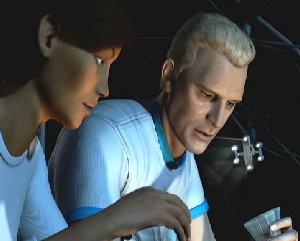
CGI Captain Blue is described in supporting literature as
Scarlet’s ‘gung-ho
battle-hungry friend’.
In
the early episodes of the CGI series (1-13), Captain Blue plays a
much less prominent role than he did in the original series.
Destiny Angel has become Captain Scarlet’s ‘unofficial’
partner and the friendship between Blue and Scarlet appears to be
far less trusting – with Blue expressing doubts that Scarlet is
free from Mysteron control in ‘Instrument of Destruction – part
2’.
In
the later episodes (14-26) Blue does feature more regularly and
there are indications that he and Scarlet are friends –
particularly in the episode ‘Storm at the end of the World’
where Scarlet shows great concern for his injured partner.
Other
Interesting facts
It
was the Captain Scarlet Annual (1967) that gave details of Adam
Svenson’s full ‘career background’ (Winning a full scholarship
to at Harvard University at 16, disappointing his father by joining
the World Aeronautic Society, and so on…) The book also stated
that he was transferred to the Security Department with the task of
weeding out ‘enemy agents’ from the service.
The
later 1993 ‘Official Captain Scarlet Annual’ states that Adam
Svenson:
‘…won
a transfer [from the WAS] to the U.S. Security Department to become
an active secret agent. With
a force of 20 hand picked agents, he set about revolutionising his
command in Eastern Europe – with such success that Bereznik, the
breakaway dictatorship opposed to the World Government took
exception to the improvements and on three separate occasions
attempted to kill him. Each
time Svenson managed, by ingenuity and quick thinking, to save
himself.’
There
is no explanation of why this background information was changed.
The
1967 annual states that Blue enjoys an outdoor life and that his
hobbies are: water-skiing, surfing and deep-sea harpoon fishing.
The 1969 TV21 Annual contains an interview with ‘Captain
Blue’ about his hobby of ‘surf-riding’ which states he is the
‘current world record holder for the longest ride’: 5,000 feet
set at Waikiki Beach, Oahu in 2064.
(This would surely have lead to a breach of security as
anyone could look up the world record holder and thus identify
Captain Blue of Spectrum.)
One
source ('Thunderbirds calendar is Go', 1987) states that he was
awarded the World Government’s highest military medal (the Valour
Star) by the World President. The
only other recipient is named as Captain Troy Tempest of the World
Aquanaut Security Patrol.
The
headline ‘Hero Award for Captain Blue’ does appear on a later
edition of the TV21 comic. The
story line includes the information that Blue is on his way to Unity
City to receive the Medal of Honour for Bravery.
The
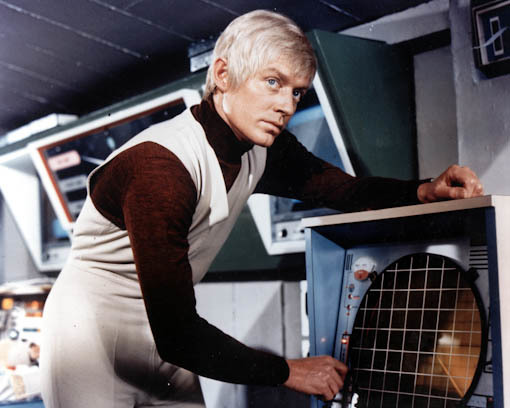
man who was Captain Blue
As
mentioned
above, Captain Blue’s facial characteristics were generally
thought to be based on Ed Bishop. However, in ‘The Complete Book
of Captain Scarlet’, by Chris Bentley (Carlton Books, 2001), Terry
Curtis, the sculptor who made the puppet, revealed that he made
Captain Blue as a version of himself, (although Sylvia Anderson had
asked that the puppet’s features be based on Ed Bishop.) The controversy
will probably rumble on for years to come.
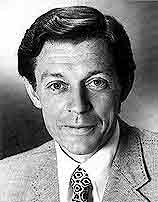
The
actor who provided the voice, Ed Bishop, was born George Victor
Bishop, in Brooklyn, New York on 11th June 1932.
He changed his name to Edward (Ed) Bishop on becoming a
professional actor,
to avoid confusion with another actor called George Bishop.
Educated
in Peekskill, New York State, he graduated from High School in 1950
and after a short spell at Teacher Training College; he went into
the United States Army in 1952 to do his National Service.
He worked in the Armed Forces Radio Services and first
started acting in a local amateur theatre group.
Once
discharged from the Army, he started a course in Business
Administration at Boston University, but in 1956 he enrolled in a
two-year drama course instead, and graduated in 1959 with a Bachelor
of Fine Arts degree in the Theatre.
He
was able to continue his studies at the London Academy of Music and
Dramatic Art (LAMDA) after winning a United States Fulbright Grant.
He stayed on in England, working on television and in the
theatre, as well as in feature films, including parts in Stanley
Kubrick’s ‘Lolita’ (1961) and ‘2001: a
space odyssey’ (1968) – although most of his scenes in
that Sci-Fi classic ended up on the cutting room floor as the film
was over-running.
In
1967, came the first of his collaborations with Gerry Anderson, when
he was cast as the voice of Captain Blue, in the Supermarionation
program, Captain Scarlet and the Mysterons.
He appeared in all 32 episodes of the series, as well as in
the audio adventures released on record.
In his authorised biography, Gerry Anderson says:
‘I was intentionally listening out of sight of the artists,
as seeing them as they do the voices can throw you.
Ed has a wonderful voice, which he often refers to as his
‘wall to wall corporate voice’, and he was instantly taken on
board to play the role of the smooth talking co-star Captain
Blue.”*
In
1969 he worked with Gerry Anderson again, on the film Dopplegänger
(Also known as ‘Journey to the far side of the Sun’)
and was cast as Commander Ed Straker in Anderson’s first
live-action production UFO.
He appeared in all 26 episodes of the series, which was
broadcast in the UK in 1970-71.
Gerry
Anderson explained his choice for the role by saying: ‘I wanted to
get somebody who was a good actor, who would turn up on time, who
was very workmanlike and who understood the British people – that
guy was Ed Bishop. I
cannot say enough in support of the man; he is everything, I think,
that a good artist should be.’**
Reviews
of UFO were mixed; people associated Anderson’s
shows with children’s adventure series and the storylines in the
new show were far more mature.
This lead to many regional Independent TV companies
scheduling it in irregular time slots; however the series did
generate a positive response and plans were well underway for a
second series, especially as, when it was syndicated in the US, it
led the ratings in New York and Los Angeles for seventeen
consecutive weeks.
However,
for various reasons, the second series was never made and Gerry
Anderson went on to make Space 1999 instead.
Bishop
went back to America in 1972 and landed a vocal role in the animated
Star Trek series, and a role in the movie Pets (1972).
He then returned to England and continued to work in films and in
roles in many TV series, most notably as the motor-mouth TV
anchorman, Jay Garrick, in all six episodes of the cult LWT sitcom Whoops
Apocalypse! He was also busy with radio productions
for BBC Radio 4. He starred as Detective Elijah Bailey in an adaptation of
Isaac Asimov's The Caves of Steel, portrayed Philip
Marlowe in a series of six adaptations of Raymond Chandler's
detective novels, and had a role as the American tourist, Al Clancy,
in The Archers.
In October 2002, he starred as John F Kennedy in the
programme Kennedy's Secret Tapes
on the 40th anniversary of the Cuban Missile Crisis.
He
worked on numerous voiceovers for television advertising campaigns.
In 2000, Ed Bishop was called on by Gerry Anderson to once again voice
Captain Blue, for a 4 minutes short movie reel to help promote a
possible new series of Captain Scarlet – to be done in CGI
animation. Francis Matthews was also called back to do the voice of
Captain Scarlet. This
movie was very popular at the fan conventions when it was shown, but
people had to wait a few more years (until 2005) before actually
being able to view the new CGI series called Gerry Anderson’s New Captain
Scarlet. Sadly, however, neither Ed
Bishop nor Francis Matthews were to be part of the voice cast –
the producers feeling that their voices sounded too old for the
characters.
Politically
active, Ed Bishop participated in the British protest against the Iraq war, in March 2004.
Ed
Bishop was a frequent guest at many Sci-Fi conventions, and remained
a firm favourite with the fans of the Anderson shows. Asked in an interview if he had an interest in Sci-Fi, Bishop
replied: ‘No, not really.
I don’t have an overwhelming interest in the subject. It was an
acting job… actors have to do this. I
keep going to conventions and getting fan mail from all over the
world, it’s extraordinary. It’s
partially to do with sci-fi, as it does stretch the imagination. Westerns and the cop genre come and go, but I think sci-fi
sticks around.’ ***
Ed
Bishop died on the morning of Wednesday, June 8th, 2005, aged 72. He
was married twice and had four children, one of whom, his son
Daniel, predeceased him.
The
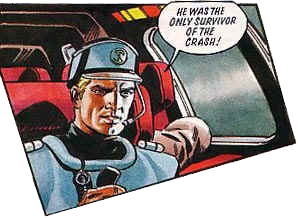
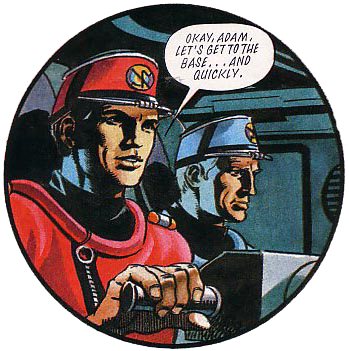
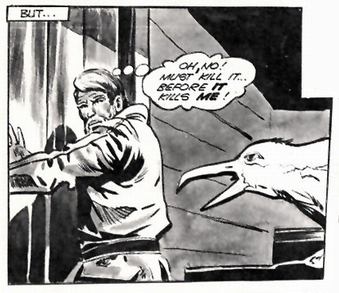
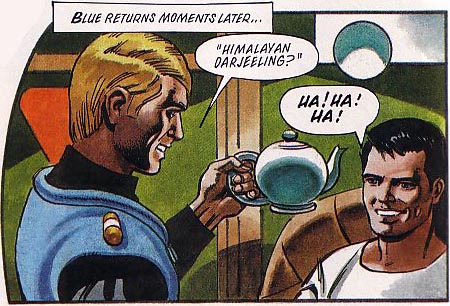
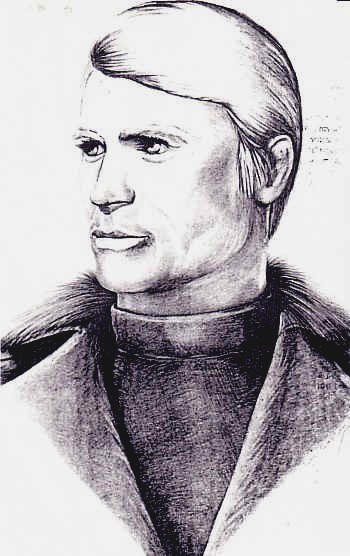
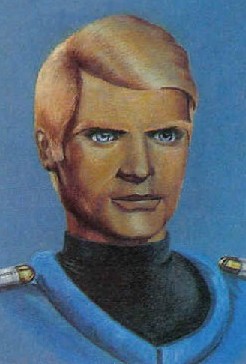
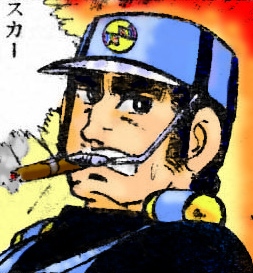
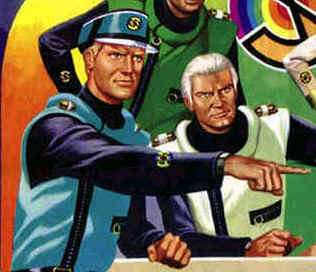
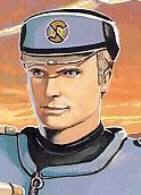
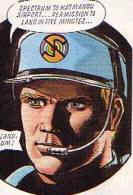
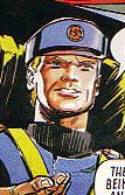
many faces of Captain Blue…
As with Captain
Scarlet, Captain Blue has been drawn by many artists, usually for
the Captain Scarlet comic strips than ran in the pages of
various Century 21 titles (magazines and annuals).
Numerous artists drew the strips and amongst them were names
such as Ron Embleton (the artist who created the ten panels for the
ending captions of the TV series), Mike Noble, Barry Mitchell and
Mike White, to name just a few.
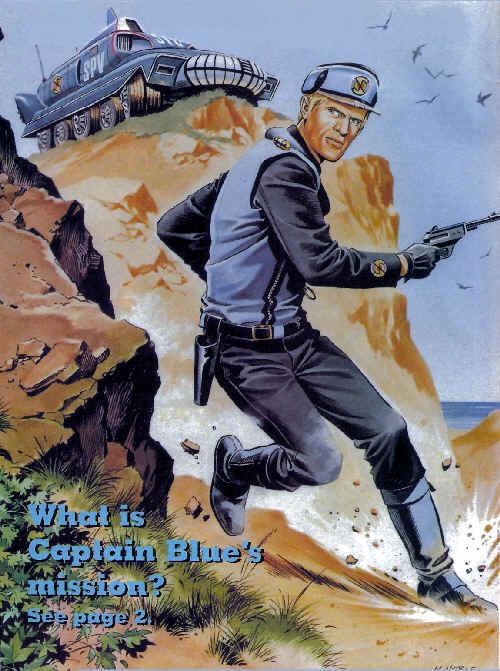
In
1993, Graham Bleathman created the covers for two ‘graphic
novels’ in which a series of Century 21 strips were reprinted.
Captain Blue graced the cover of the second book, along with Captain
Scarlet, an Angel aircraft and a Spectrum Pursuit Vehicle.
|
Embleton
|
Noble
|
Mitchell
|
White
|
Bleathman
|
|
|
An interesting
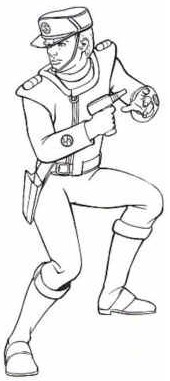
portrayal of Captain Blue featured in the activity books
produced by Carlton Books Limited, in 2001.
Although drawn in a ligne claire style, the
artist of the 'Captain Scarlet Tattoo Book' still was
able to capture the heroic essence of the character.
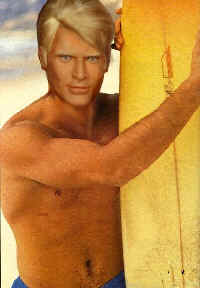
In the 80s, artist Lynn Simpson drew a series of
Spectrum portraits, featuring Captain Scarlet, Colonel White,
Captain Ochre, Captain Black and of course Captain Blue.
Years later, she drew another portrait of the dashing
blond captain, for one of the short-lived 'Captain Scarlet & the Mysterons' comics,
which were published between 1993 and 1994.
|
|
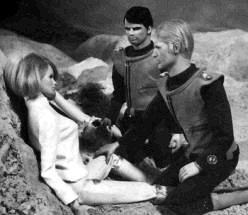
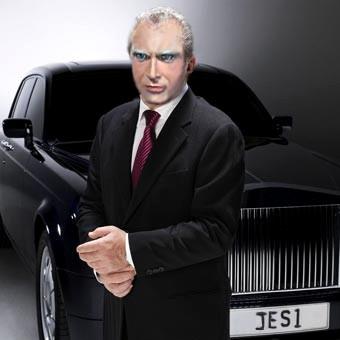
Although
the original series finished after 32 episodes, the Captain Blue
puppet made a few noticeable reappearances afterwards, heavily
disguised under a dark wig, in another Supermarionation show, Secret
Service – this show also featured a number of other puppets from
the Captain Scarlet show, including Captain Scarlet himself, as a
recurring character, the bumbling agent Paul Blake.
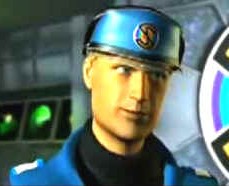
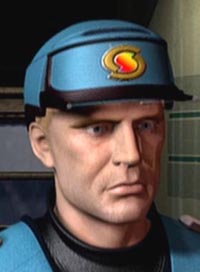
The character of Captain Blue, created for the CGI
series, is not to be confused with the original Supermarionation
character. Very
different physically, and with a different background, the CGI Blue
also has a very different attitude.
There is really little resemblance between the CGI Blue – a
gung-ho, Rambo-like character – and its smooth-spoken, much less
impetuous predecessor; although
both characters share a similar kind of friendship with their own
Captain Scarlet, and have the same heroic approach to facing danger
in order to do their duty and save their friends’ life.
In that example, a close comparison can be made between the
original Blue and the CGI character in the classic series episode,
‘Manhunt’ and the CGI episode, ‘Homecoming’.
|