|
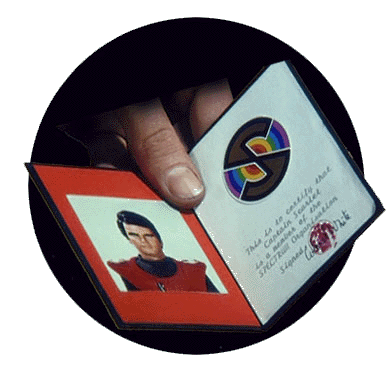
Spectrum
designation:
|
Captain
Scarlet
|
|
|
Rank and
attributions:
|
Senior
staff officer, colour-coded Captain, Spectrum's number one field
agent.
|
|
Real name :
|
Paul Metcalfe
|
|
Place of birth :
|
Winchester, Hampshire, England
|
|
Date
of birth:
|
17 December 2036
|
|
Height:
|
6 Ft. 1 Ins.
|
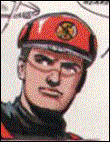
|
Weight:
|
172 Lbs
|
|
Eyes:
|
Blue
|
|
Hair:
|
Black
|
|
Puppet
specifications:
|
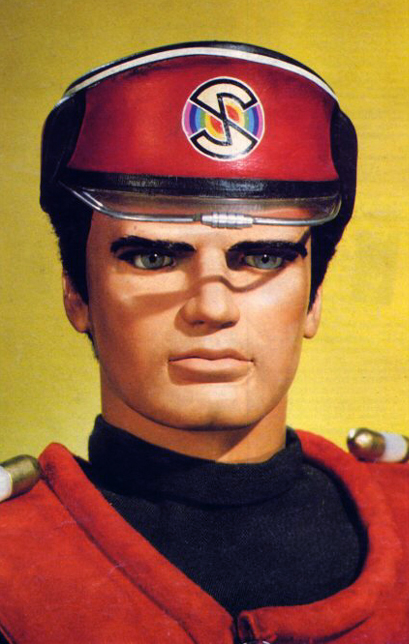
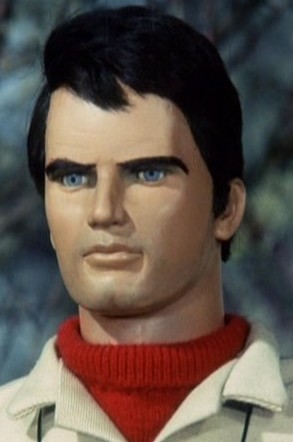
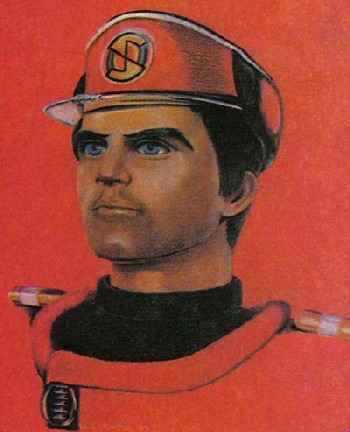
Facial
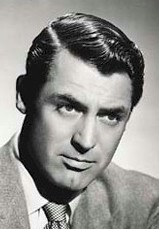
features and voices based on a young Cary Grant. Voice
provided by Francis Matthews.
|
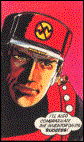
Personal
history
Paul
Metcalfe was born in Winchester on December 17, 2036, into a family
with a long military history; his father, grand-father and
great-grandfather all served in the World Army, where they all
distinguished themselves. It
was natural that Paul would also follow the family tradition by
choosing a military career. He graduated from Winchester University in 2057, at the age
of 21, with degrees in History, Technology and employment of
Mathematics, and then went to West Point Military University in New
York State, U.S.A., where he was trained in field combat duty, how
to pilot a variety of aircraft and to become an expert with hundreds
of weapons, from the most sophisticated to the most ancient
(2059-2063). Drilled to survive in any conditions, he
demonstrated a strong mental resilience, a concern for others over
his own safety, and an ability to command.
Acclaimed as ‘Supreme Soldier’ by fellow students and
lecturers alike, Paul left West Point and joined – or was
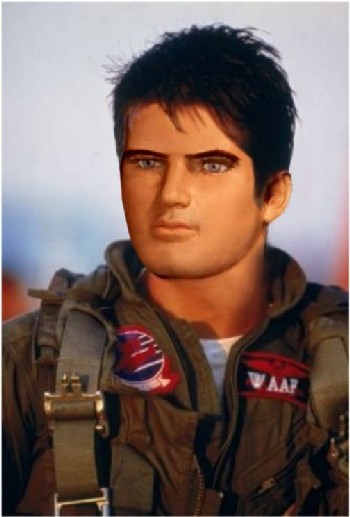
transferred – to the World Army/Air-Force.
Some sources say that he joined the WAAF on the low rank of
private, rather than take up the commission which his cadet training
entitled him to (but this seems to be unlikely, considering the
investment put into his training at West Point).
Nevertheless, with his ability to command and his
professional military outlook, he gained promotion after promotion,
until, within two years, he had reached the rank of Colonel – the
youngest the WAAF had known to date - and had seen action in all the
corners of the globe.
The
selection committee charged with finding candidates for the
formation of the new organization of Spectrum, had followed Paul’s
career, and recognized his qualities of leadership, initiative,
combat strategy, integrity and his dedication to his work within the
WAAF. Therefore, in
2065, he was approached by them and accepted the offer to become a
field agent for Spectrum, with the rank of Captain, and the colour-code
name ‘Scarlet’.
In
2068, came the Zero-X expedition to Mars, where Captain Black
discovered the Complex of the Mysterons and destroyed it, mistakenly
believing they were attacking his vehicle and crew.
Black was then taken over by the Mysterons, who vowed to
avenge themselves, by declaring a ‘War of Nerves’ on an
unsuspecting world. Their
first threat was aimed at assassinating World President Younger.
Whilst driving in a Spectrum saloon car, on their way to meet with
the World President, Captains Brown and Scarlet were killed when
their car was forced to crash.
They were then ‘Mysteronised’, duplicated from the
original dead bodies, to do the bidding of the Mysterons.
After Captain Brown’s failure to carry out the Mysterons’
threat, it was up to the doppelganger of Scarlet to perform the
second attempt. Kidnapping
the World President, Scarlet brought him to the top of the London
Car-Vu car park, with Captain Blue hot in pursuit.
In a last showdown, Blue shot Scarlet, who fell
800 feet from the top of the Car-Vu.
The
Mysterons then either lost or released Scarlet from their control,
and he became Spectrum’s indestructible agent in their continuing
battle against the Mysterons. (See episode 1, “The Mysterons”.)
|

|
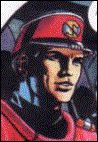
Personality
profile
Scarlet
is reliable and trustworthy, with a driving sense of honour, shown
when he risked his career to save Colonel White’s life after he
realised that a disagreement he had had with him was his mistake
(“White as Snow”). Because
of his unique abilities, he would often risk his life – and even
apparently ‘die’ - to
carry out a mission to the end – knowing that it was far better
for him to risk himself and revive, than to let other Spectrum
agents sacrifice
themselves.
On
duty, Scarlet is a true professional, totally reliable and carrying
out his orders quickly and efficiently. Off duty, though, he changes
completely. He is full of fun,
carefree and bursting with energy, emotional and physical,
possibly as a result of his regenerative abilities. Scarlet is also
very popular with his fellow Spectrum officers and is especially
loved by the Angel pilots who find his personality charming and
appealing. However, Scarlet also has a recurring tendency towards
distancing himself from others, especially with crowds – probably
feeling that, although still very human, he is now very different
from other human beings.
One
of Captain Scarlet's hobbies when off-duty and away from Cloudbase
is pot-holing (according to the TV21 Annual published in 1969), a
hobby that offers him excitement and danger.
Fanfic
stories show him playing chess – and often winning (Mary J.
Rudy's 'An Exercise in Hope' and Chris Bishop's 'Turning Point', to
name but a few) and fencing ('The Quest', by Chris Bishop) and
although these two activities are not listed in any official
sources, it seems like natural that a man with Scarlet's background
would have some interest in them both.
|
|
His
powers

With
Captain Brown, Captain Scarlet was the first known human being to
have been subjected to the process of retrometabolism by the
Mysterons (It is unknown if Captain Black had truly been
Mysteronised on Mars, or if he is still human). Scarlet is also the
only known human being, to date, to break free of Mysteron control,
and the reason why that happened is still a mystery, although many
theories have been proposed. Remaining
loyal to Spectrum, he became the organisation’s most effective
weapon against the Mysterons, for he retained from his experience
the power of retrometabolism. He can heal from any wound, even a mortal one, in a matter of
only a few hours, without even a scar to remind him of the incident.
Scarlet
can also feel the presence of a Mysteron agent nearby or when
danger, related to the Mysterons, is imminent – although this
particular ability, for some unknown reason, does not work all the
time. This ‘sixth
sense’ manifests itself in the form of nausea and dizziness.
Scarlet also retained the strange imperviousness to X-rays
– he shows a ‘normal’ image from an X-ray shot –
like all Mysterons agents, and like them, he seems to be
vulnerable to high voltage electricity.
It has
been postulated that Scarlet’s body works like a walking solar
battery, constantly recharging itself, holding energy in reserve to
heal wounds. He
therefore needs very little sleep, as seems to be indicated in
episodes such as “Lunarville 7”, “Inferno”, “Shadow of
Fear” and “The Trap”, where we see him prowling corridors at
night-time. Other
theories – mainly by fanfic authors – suggested alcoholic
beverages or medical drugs would have little or no effect on him –
or that his body would have to absorb an enormous quantity before he
would feel any effect, the speedy metabolism of his body burning any
foreign substance nearly as soon as it enters his bloodstream.
|
|
Electricity: inconsistencies
|
|
 |
|
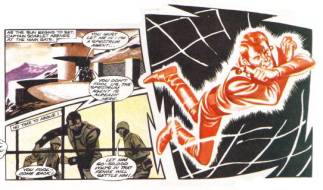
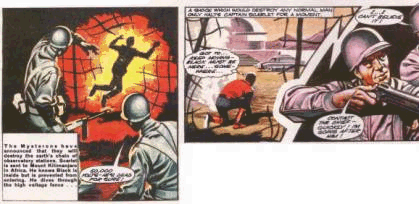
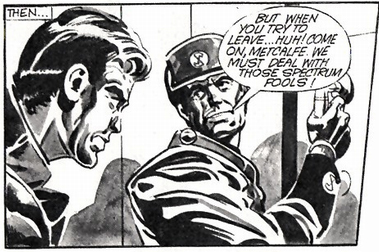
Panels
from the 'Observatory Network' storyline, drawn by Ron
Embleton |
All
the series created by Century 21 generally abound with
inconsistencies; between TV series stories and comic strip stories,
and between them and articles. Captain Scarlet and the Mysterons is
no exception to this. Mentioned above (and below) are
inconsistencies regarding the character’s background, but also
worth mentioning are inconsistencies about Captain Scarlet’s
vulnerability – or lack of – to electricity.
While the TV series seems to indicate that Scarlet might be
vulnerable to high voltage electricity as are other Mysteron
reconstructs – people and objects - it seems that in early comic
strips in some instances, the authors didn’t care to focus on that
vulnerability, and Scarlet is seen on several occasions being
electrocuted and walking away from it.
Later
strips do mention a possible vulnerability to the Mysteron rifle
(also known as the ‘electron rifle’) which uses electricity to
kill Mysterons. In the
last years of comic strips, the authors wisely did not commit
themselves – and in one strip at least, we have Scarlet pondering
whether he is vulnerable to electricity or not, but nevertheless
going to the rescue of a Cloudbase technician trapped by high
voltage wires.
It
is also interesting to note that in the same TV episode (Operation
Time) in which it is discovered that the Mysterons are both
impervious to X-rays (a Mysteronised body shows a ‘regular’
picture instead of an regular X-ray pic) and vulnerable to
electricity, Captain Scarlet demonstrates his indestructibility once
more, by taking the place of the of the Mysterons’ intended victim
on an operation table for brain surgery.
However, it appears that the ‘Cerebral-Pulsator’, used
during the operation, sends electrical pulses directly to the
patient’s brain. It
could be theorised that the amount of electricity used by the
Pulsator would have been insufficient to harm Scarlet – that or,
contrary to later statements in the series, Scarlet is not as
vulnerable to electricity as Spectrum seemed to think he is.
It is understandable that Scarlet is not that eager to put
this to the test.
|
|
About Rhapsody
Angel…
 There is no official source that
supports a relationship between Captain Scarlet and Rhapsody Angel,
as described in fanon. Mary
J. Rudy was the first to mention a romantic link between the two of
them, and many fanfic writers have followed in her stead.
However,
it is quite possible that this idea might have found its source in
Century TV 21 books and magazines. Rhapsody Angel is, more or less,
the central character of the early “Angels” comic strip, and she
is also the ‘star’ of one of the two stories featured in the
“Angels” storybook from 1968, in which, along with Scarlet, she
helps save a potential victim from the Mysterons – being awarded a
medal at the end, with Scarlet. It is worth mentioning that Rhapsody
also has a long, important chapter to herself in the book “The
Angels and the Creeping Enemy”, by John Theydon.
But it’s probably the novel “Captain Scarlet and the
Mysterons”, also by John Theydon, that gives weight to the ‘rumours’.
In the beginning of this book, Captain Scarlet leaves
Cloudbase for a furlough in London, where he meets Rhapsody on a
date – which is cut short by a Mysteron threat.
By the end of the book – in which Rhapsody plays a more
prominent role than any of her Angel colleagues – Scarlet
reiterates his invitation of a date immediately on his recovery in
sickbay… We might add to all these observations, just for
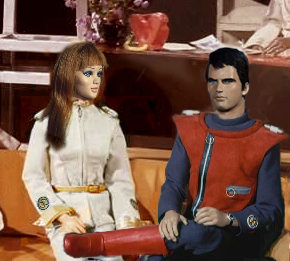
reference, a curious promotional photo, showing Rhapsody Angel
wearing Captain Scarlet’s distinctive Spectrum cap, which was
featured in, amongst other places, Chris Drake’s reference book,
“Captain Scarlet and the Mysterons”.

While this
relationship with Rhapsody is open to interpretation, it is largely
accepted that Captain Scarlet and Destiny Angel do, at least, know each other well enough to
be good friends, and may have been – or may still be –
romantically linked. As
Chris Drake suggests in the 1993 reference book ‘Captain Scarlet
and the Mysterons’ – that would explain why Destiny is called on
to identify the body of Scarlet at the end of episode one. Also,
note that the New CGI series has drawn a positive romantic link
between Scarlet and Destiny.
|
|
About his family…
 |
|
Undercover
Paul Blake, in 'Secret Service' |
 |
|
The
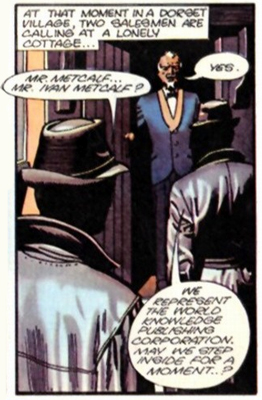
fate of Ivan Metcalf(e) in 'Holiday of Terror', by
Keith Watson |
|
 |
|
Adrian
Metcalfe and Captain Black in 'Landslide', art by Jim
Watson |
|
Although
it is mentioned in the official sources that Scarlet is the ‘son,
grandson and great-grandson’ of a long line of military officers,
there are no more details given for his family.
An article from Century TV 21, prior to the launching of the
Captain Scarlet TV series, mentioned a brother named Ronald, who was
a banker. In comic strips, we find an uncle, Ivan Metcalf
(sic), who was Mysteronised in the story “Holiday of Terror”,
and a cousin, Adrian Metcalfe, who also was Mysteronised in yet
another strip, "Landslide". However, some fans might
consider that these
characters should not be viewed as part of the official background,
as they do not consider the comic strips and articles from Century
21 as ‘canon’. A further analysis of details given by the comic
strips, would suggest the family details are simply
‘inconsistencies', as the identity of Captain Scarlet, which is
supposedly a secret from the world at large - as are the identities
of all the other Spectrum members – seems to be known to the
general public.
Aside from the above example, Paul
Metcalfe is generally considered to be an only child, at least in
fandom. The generally
accepted names of Paul’s parents, Mary and General Charles
Metcalfe, are purely fanon, the creation of Mary J. Rudy for her
stories, and these have been used by many other authors since.
The history created for the character
in the New Captain Scarlet CGI series, gives American
astronaut Tom Metcalfe and British astro-physicist Ann Brightman
(both deceased) as Paul’s parents, as well as a sister and a
nephew (unnamed to date). However,
take note that the CGI character should be considered as a different
character from the Captain Scarlet of the classic series.
The
Century 21 magazine from 1993 also made an interesting family link
with the character of BISHOP agent Paul Blake, from the Secret
Service Supermarionation series – which was ‘portrayed’ by the
Captain Scarlet puppet. According
to the article found in the magazine, Paul Metcalfe was the grandson
of Blake, who used the name ‘Adam Metcalfe’ as a pen-name to
write novels. To avoid
this being another inconsistency in the official character history
(which stated that Paul’s grand-father and great-grandfather were
military officers), it was assumed in that Paul Blake was his
maternal grandfather – the father of fanfic character ‘Mary’
Metcalfe – an idea which has been used in fanfic stories by Chris
Bishop and now seems to have been accepted into the fanon.
|
|
Other interesting
facts
Captain Scarlet, while obviously
being the most experienced soldier in Spectrum, is also the youngest
of the colour-coded officers, by at least a year.
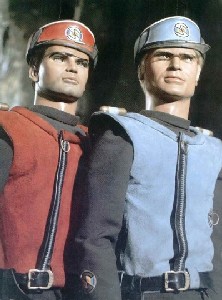
He is one of four members of the Spectrum senior staff who
are of British origin. The
others are: Colonel White, Rhapsody Angel, and ex-Spectrum agent,
now Mysteron agent, Captain Black.
Captain
Blue – the Spectrum agent who shot him down from the top of the
Car-Vu – is now Captain Scarlet's most regular partner, and best
friend. This
relationship of theirs doesn't only exist in the TV series, but also
in other media as well (comic strips, novels, etc.)
Captain Scarlet’s most notable
character traits might be those of a loyal and courageous man, but
he can also be impetuous and is often regarded as arrogant; perhaps
due to his invulnerability.
It is still unknown exactly why Scarlet escaped
Mysteron control and regained his personality.
The most interesting theory –
and probably the most acceptable one to date – comes from
Chris Drake’s book, stating that maybe Scarlet wasn’t
‘properly’ dead when he was Mysteronised in the first place, and
that he was fighting for his life at that very moment.
It is possible that the Mysteronisation process also copied
Scarlet’s personality and will to live, and that it went into
dormancy while the duplicate was carrying out his orders from the
Mysterons. When the
duplicate failed and the Mysterons abandoned him, the original
personality took over once more.
This theory seems to appeal to many fanfic
authors.
In the original script for the pilot episode, when he
was killed by the Mysterons, Scarlet was replaced by some kind of
robot. After the
Mysterons lost their hold on their agent, the Cloudbase computers
would have been used to re-program this new Scarlet so he would
become an agent of Spectrum. But it seems that this idea was dropped, when it was
realised that the viewers would find it difficult to relate to a
hero who was a mechanical man - and so the indestructible hero, made
of flesh and blood, was born instead. Some of the old concept,
though, like the mention that computers were used to help Scarlet
regain his humanity, remained in the script of the first audio
adventure, 'Introducing Captain Scarlet', as well as some Century TV
21 articles.
|
The many
faces of Captain Scarlet
 |
|
Captain
Scarlet |
|
 |
|
Cary
Grant |
|
 |
|
Francis
Matthews |
Despite
rumours that the puppet's appearance had been based on the young
Roger Moore’s features - even
Moore himself thought that – Captain Scarlet’s face
and voice were based on Hollywood British-born actor Cary Grant, as
he looked in his early thirties, during the height of his career in
the 40s.
Born
Archibald Leach in Bristol, England, and joining a troupe of acrobats
while still a teenager, he found himself in the U.S. during a tour
and decided to stay there. Training
as an actor, and changing his name to Cary Grant, his career started
when Mae West, searching for a new leading actor for her latest
movie noticed him and said ‘if he can talk, he’s the one I
want.’ Playing
action, war, drama, but especially comedy movies, Grant’s career
spanned from the 30s to the late 60s when he retired to raise his
only daughter. Amongst his numerous and most memorable movies can be
counted classics such as ‘Gunga Din’, ‘Arsenic and old
Lace’, ‘Bringing up Baby’ and ‘Notorious’ and ‘North by
Northwest’, two of the four Alfred Hitchcock’s movies he played
in.
 |
|
Matthews
with Tingwell in 'Dracula, Prince of Darkness' |
 |
|
as
Paul Temple |
The voice of Captain
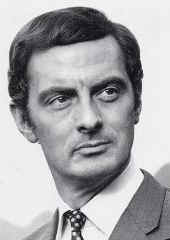
Scarlet was provided by British actor Francis Matthews, who,
reportedly, was not
auditioned for the role of Scarlet. According to Matthews himself,
Gerry Anderson had heard him doing an impersonation of Cary Grant
and decided that was the voice he wanted for his hero. Although,
still according to Matthews, Gerry Anderson ‘didn’t move heaven
and earth to get him he certainly came close to it’.
Prior
to “Captain Scarlet”, and outside of Century 21 Productions,
Francis Matthews played in many movies, notably in a few of Hammer
Films productions: "The
Revenge of Frankenstein", as the doctor's assistant (1958),
"Rasputin, the Mad Monk", in 1966, as one of the
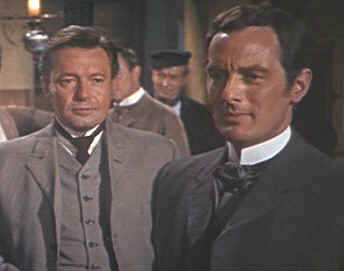
conspirators, and in the same year, he starred as the hero in
“Dracula, Prince of Darkness” with Charles Tingwell playing his
brother. Tingwell was also cast in “Captain Scarlet” as the
voices of Doctor Fawn, the ill-fated Captain Brown, and a number of
supporting characters. "Captain Scarlet and the Mysterons"
was the third project in which the two men worked together, as in
1964, they had met on the set of "Murder Ahoy", one of
Margaret Rutherford's Miss Marple movie, in which Tingwell played
Inspector Craddock, and Matthews landed the role of one of the
villains of the movie. From
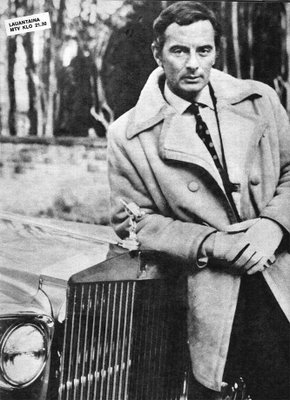
1969 to 1971, Matthews took the title role in the TV detective
series "Paul Temple".
|
|
|
|
|
Detail
from one of Ron Embleton's end credit panels |
|
|

|
|
Mike
Noble's art for 'Secret Mission' |
|
|

|
|
Art
box for Japanese puzzle |
|
|
|

|

|
|
Portraits
by Lynn Simpson |
|
 |
|
Paul
Blake, in 'Secret Service' |
|
 |
|
Detail
of Embleton's poster |
|
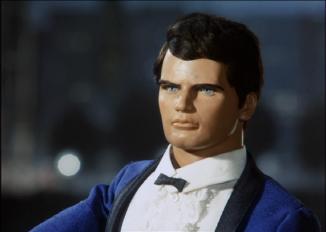
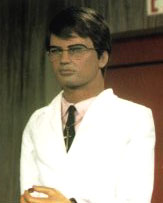
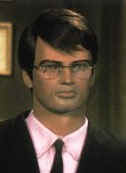
As previously stated the Captain Scarlet puppet,
‘heavily’ disguised under a light brown wig and spectacles, was
later used as the character Paul Blake, the assistant to the Bishop,
in “The Secret Service” series.
In later years, TV Century 21 would explain that this
character was Captain Scarlet’s grandfather.
Soft-spoken, quiet and often bumbling, Blake has little in
common with dashing, self-assured, authoritative Scarlet, except for
his appearance.
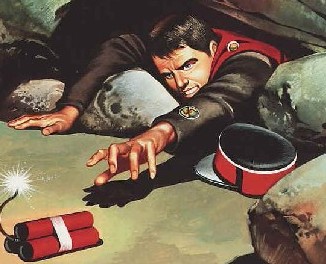
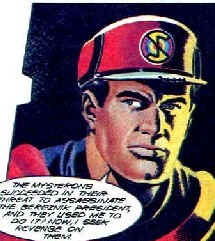
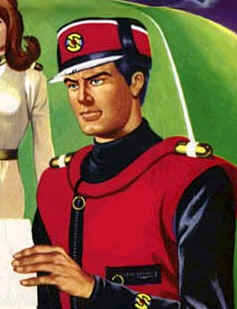
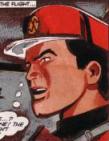
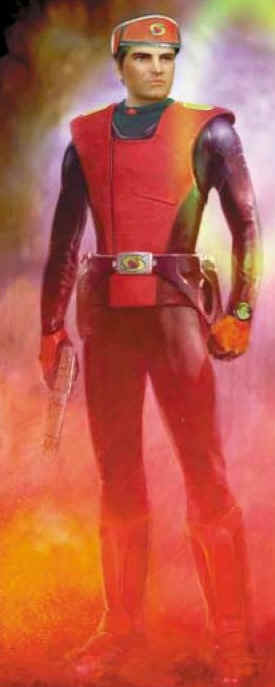
For the Century TV21 comic strips
that preceded and then followed the adventures of Captain Scarlet on
TV, many famous artists drew the features of the indestructible
hero, the first amongst them being Ron Embleton – who also created
the ten wonderful panels that were used for the TV series end
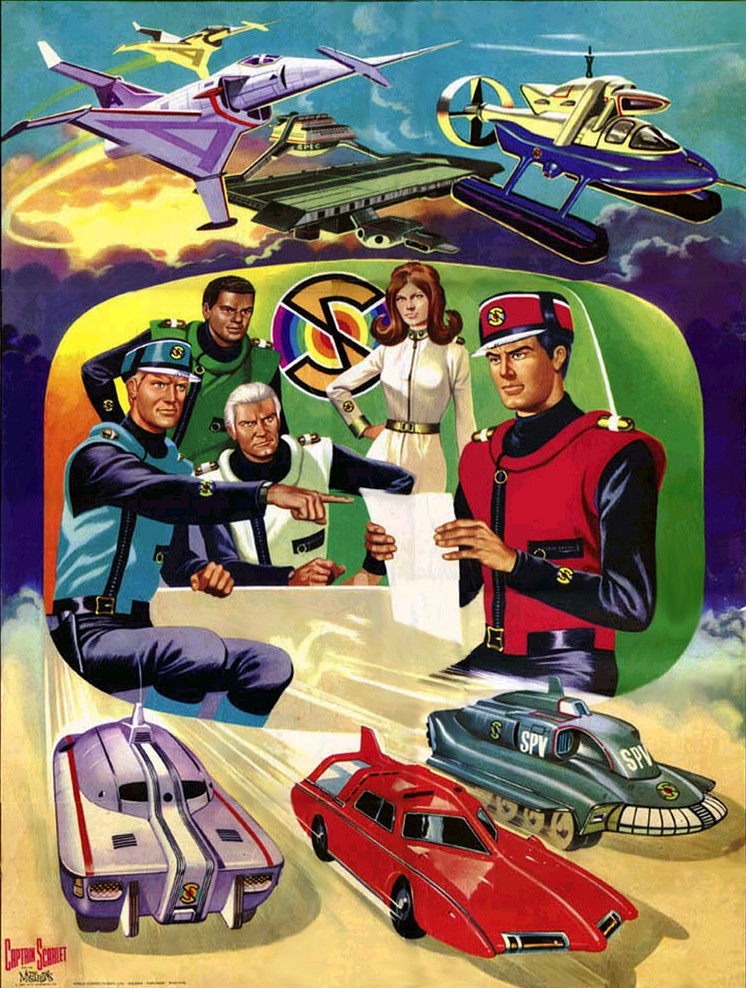
credits. Embleton
also drew a beautiful
poster for the Anglo Confectionary bubble gums cards,
featuring
Captain Scarlet, other
characters from
the TV series: Captain Blue, Colonel White,
Lieutenant Green and (possibly,
judging by the hairstyle) Symphony Angel.
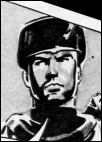
In the comic strips, Mike Noble
followed Embleton's run, and did a wonderful job drawing many stories that
are amongst the most renowned today.
Frank Bellamy – of Thunderbirds and Fireball XL-5 fame –
even did a short turn on the strip, before being followed by, to
name only a few, Keith
and Jim Watson, Don Harley, John Cooper, Barry Mitchell and Mike White.
 |
|
From
'We will destroy Unity City', by Ron Embleton |
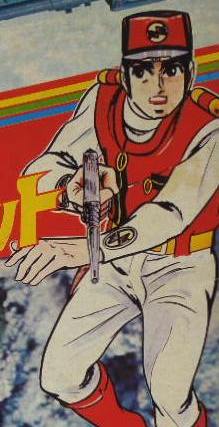
Very
popular in Japan, "Captain Scarlet and the Mysterons"
received the rare and in those days unusual honour - for an
occidental TV series – of being adapted into manga-style comic
strips, for the manga
magazine, Shōnen Book, under the title... 'Captain Scarlet'
The strip, created by Hikari
Asahioka, ran from January to August 1968.
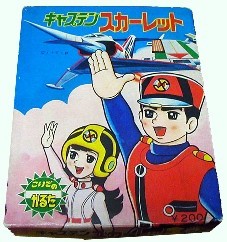
It was
still in early Manga-style, that one of the most unusual Captain
Scarlet drawings can be found, on the box art of a Japanese
children’s puzzle, created during the 70s.
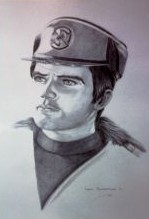
In the
80s, artist Lynn Simpson created a beautiful series of drawings
featuring Captain Scarlet, Captain Blue, Captain Ochre, Captain
Black and Colonel White. The
series, which was published in Fanderson publications, is probably
amongst the rarest and most beautiful renditions of Captain Scarlet
by a fan – who also happens to be a gifted artist.
Years
later, Lynn Simpson created a new drawing of 'Captain Scarlet' –
this one in colour, which appeared in the first issue of the
'Captain Scarlet and the Mysterons' magazine, published by Fleetway
in 1993. This drawing
was to be the first of a series of 'Spectrum portraits' that Lynn
Simpson made exclusively for the magazine.
|
|
|
|
New
Captain Scarlet (CGI style)
 |
|
'Gamer'
version |
|
 |
|
Ten
minutes test version |
|
 |
|
Promotional
flyer version |
|
 |
|
Final
version |
|
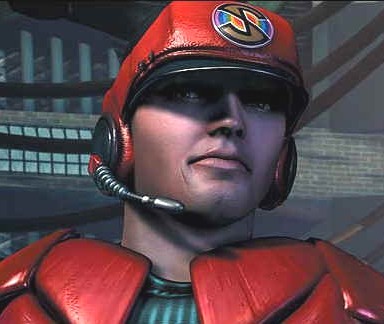
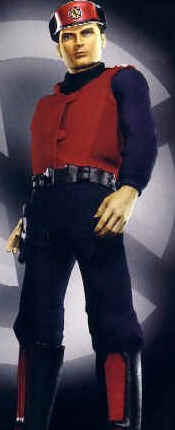
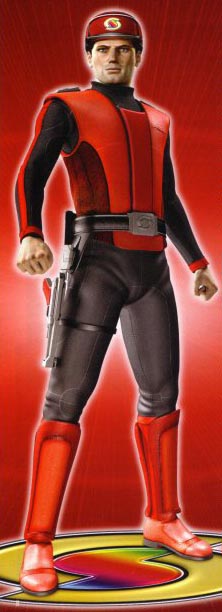
The latest incarnation of Captain
Scarlet is, of course, that of the character created for the "New
Captain Scarlet" CGI series.
It was a long process, however, before the new series even came to
life.
First,
in the 90s, two very short test movies of a few seconds were created
in CGI. The first
footage didn’t show Scarlet at all, but focused on the
‘resurrection’ of Captain Black in a cemetery scene; the other
short, however, closely resembled a video ‘pursuit’ game,
showing the Captain Scarlet character fully clad in an armour-like
uniform. This latter
version was, fortunately, dismissed, but we did get a good view of
his face, and it was very similar to the original puppet.
The ‘Captain Black’ test
movie
was
kept as the basis for a new test movie of about ten minutes long, featuring the
voices of both Francis Matthews and Ed Bishop (as Captain Blue).
Presented to fans at a Fanderson convention, reactions were
so enthusiastic that a project was started for a new Captain Scarlet
series, made totally in CGI.
Yet
again, the features of the New Captain Scarlet went through a few
alterations from promotional flyer to production, before finally
achieving the version that appears in the new series.
While in production, quite a few other changes happened, that
made the CGI series totally different from its original
Supermarionation inspiration.
Although
in the CGI series, the character of Captain Scarlet kept his real
name of Paul Metcalfe, his official biography underwent a drastic
change. Now
English-American (the voice was provided by Wayne Forester, whose
accent fluctuates in the TV series), and still born in Winchester,
his mother is Ann Brightman, an English astro-physicist, and his
father, American astronaut Tom Metcalfe, the first man to walk on
Mars. Both his parents were killed during the outbreak of global
terrorism (under non-divulged circumstances) and Paul, who wanted to
follow in his father's footsteps, instead joined the U.S. Special
Forces. It's there that he met with Conrad Lefkon, with whom he
became friends, and both of them were eventually recruited by
Spectrum, to become respectively Captain Scarlet and Captain Black.
In this version of the story, Scarlet is sent with Black to Mars,
but it is still Black who fires on the Mysteron complex, thus
starting the war of nerves. Taken over by the Mysterons, Scarlet tries to destroy
Spectrum's flying headquarters, Skybase, only to be stopped by
Captain Blue (in a way reminiscent of the original series), and then
become free of the Mysterons' influence and indestructible. (As seen
in 'Instrument of Destruction', Parts 1 and 2).
From the beginning of this new series, we learned that
Captain Black is involved in a romantic relationship with Destiny
Angel, but following the events described above, and as Black
became, after Scarlet's failure to carry out the Mysterons' plans of
destruction, the main agent of the Mysterons on Earth, Destiny
becomes involved with Scarlet, thus creating a very tense and
interesting triangle between the three characters.
|
|
Casting
call for live action movie…
 |
|
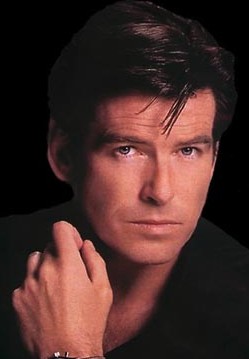
Pierce
Brosnan |
 |
|
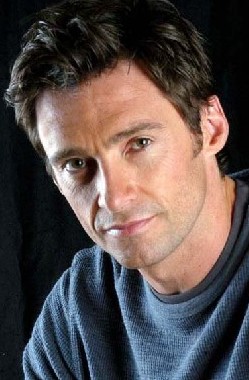
Hugh
Jackman |
However
unlikely the event of a live-action movie for Captain Scarlet is,
this webmaster’s choice would go to Hugh Jackman (Wolverine, in
the X-Men movies) to portray the indestructible Captain.
Of course, if the movie had been done ten to fifteen years
ago, the obvious choice for the hero, without any doubt, would have
been Irish actor Pierce Brosnan, of James Bond fame… who, in his
time has even been dubbed ‘the Cary Grant of the 80s’.
This is a personal choice, of course, and you may have your own
ideas of who might play the dashing indestructible Captain
Scarlet. There's probably many other candidates out there!
|

|