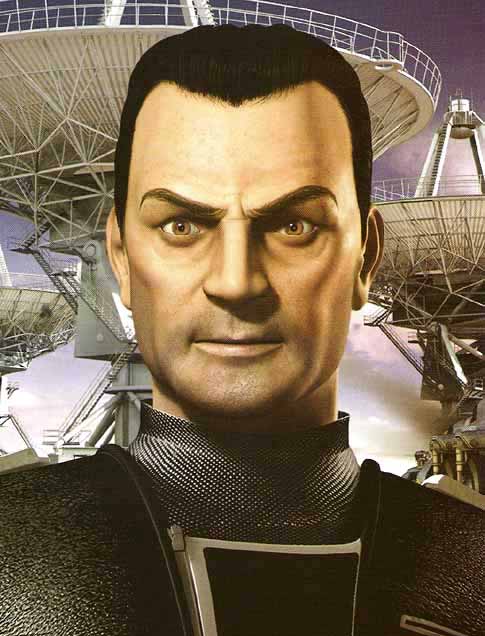
MYSTERON AGENT
|
|||||||||||||||||||||||||
|
|||||||||||||||||||||||||
|
Personal history
Born March 17, 2029, in Manchester, England, tragedy marked the life of Conrad Turner from an early age: his parents were victims of the Atomic War that rages from 2028 to 2034; he was only seven months old. Raised by distant relatives who provided a decent home, but deprived him of any affection or emotional support, he grew up to reflect the cold and hard environment that was all he’d experienced. Although of English origins, it is noticeable that, before he is Mysteronised, Turner speaks with a North-American accent, which could hint that the relatives he lived with were Americans, and that he stayed there for some years. An alternative theory – given that his secondary education takes place in the UK - is that after many years working closely with Americans he has acquired a similar accent. Conrad Turner received a good education and when he was fifteen, he entered Manchester Technical Academy, a part of the Northern University. Unable to overcome his natural reclusiveness, Conrad devoted himself to his studies and after only eighteen months he graduated with diplomas in Physics, Space Navigation and International Law. He entered Northern University and obtained degrees in Science and Technology in a further eighteen months.
Now eighteen years old, Turner joined the British Air Force. The following year (2047) Britain was plunged into a civil war. Turner was badly burned in the incident that earned him the recognition of the World Government. Disobeying his orders, the young pilot flew a sabotaged plane away from his base out over the Atlantic, where it exploded harmlessly. Ejecting moments before the explosion, Turner’s body was found charred almost beyond recognition. Surgeons worked for six hours to save his life. Turner believed that he had escaped death because of his ambition to see a world at peace. His statement: ‘Peace is what I want to see. A secure world. I can’t do much about it if I’m dead,’ made him front page news.
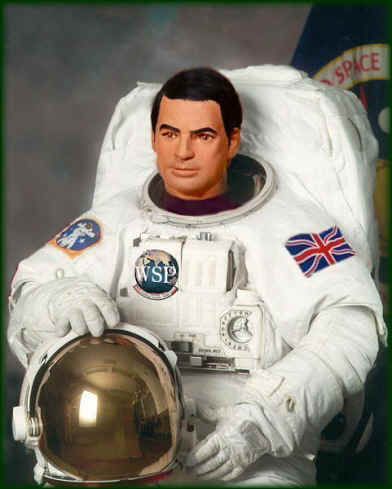
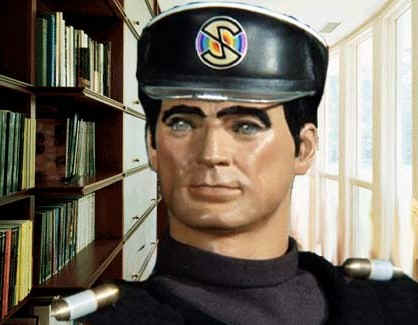
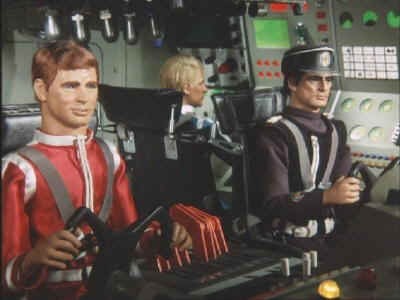
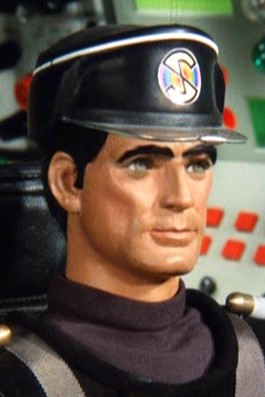
Several years later, he transferred to the World Space Patrol as the commander of Fireball XL3, which brought him more media attention, and he became one of the WSP’s most famous officers. His achievements were constantly praised by the Government and he was one of the first men considered when Spectrum was being planned. Hired early on, it was under his supervision that the individual components of Cloudbase were assembled together in space by WSP and WAAF engineers, who used an apparently decommissioned weather satellite as their base. Turner pushed his crew to finish the work in record time, and, when Cloudbase was ready, he piloted the huge craft down into Earth’s atmosphere, 40,000 miles above the surface. Given the codename Captain Black, Turner was appointed to teach the other recruits espionage, self-defence, mechanics and flying. He was responsible for many new techniques and was considered to be Spectrum’s number one agent. |
|||||||||||||||||||||||||
|
Captain Black and the Mysterons
Captain Black was the obvious choice of Spectrum agent to lead the Martian expedition to investigate the strange signals picked up by Cloudbase’s powerful communication system. With a crew of two men, Lieutenants Dean and Conway, Captain Black took the Martian Exploration Vehicle to explore a hitherto unknown region of the red planet.
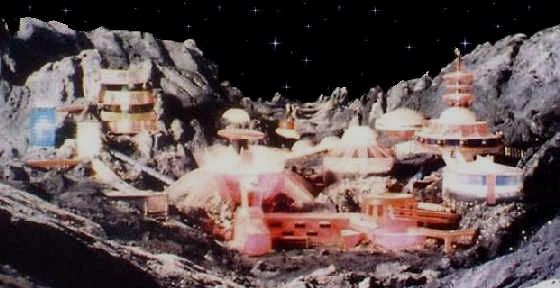
When the MEV breasted a ridge and saw the alien city in the valley below, Black mistook the intentions of the Mysterons and believed they were hostile. He destroyed the city and watched as the Mysterons revealed their power of reversing matter – retrometabolisation – as they re-created their devastated city before the eyes of the Earthmen. Determined to be revenged for this unprovoked attack, the Mysterons took control of Conrad Turner to use as their own agent in the War of Nerves they declared against the Earth (as seen in the pilot episode 'The Mysterons'). |
|||||||||||||||||||||||||
|
Personality profile
As a human, Conrad Turner was a thoughtful and reclusive character. Possessing great courage and determination, he would push himself and whoever was with him to the limit to accomplish the task at hand. He thought of himself as a man of peace, and, as he stated, his greatest wish was for world peace and an end to war. Although considered a logical and quick thinker, able to make decisions on the spot, he is also capable of reckless and impulsive actions, as he demonstrated on several occasions in his life – especially when he first encountered the Mysterons. Now a Mysteron agent, Captain Black is cold, calculating, and unemotional, and seems to be totally under his new masters' control, taking his orders directly from them. His human emotions and individuality seemed to have disappeared, or at least, to have been buried very deeply. On rare moments, some of Black’s human feelings do seem to make a brief reappearance, as seen in ‘Manhunt’. |
|||||||||||||||||||||||||
|
Captain Black: Mysteron Agent
Although some sources ('Captain Scarlet Annual 1968') state that Captain Black died on Mars and was recreated as a Mysteron agent, this is not shown on the television show and, logically, there seems to be little way for Spectrum to know what exactly happened to him. In episode 1 of the series, 'The Mysterons', Colonel White simply says of Captain Black that he ‘disappeared without a trace’. The Mysterons’ threat that ‘one of you will be under our control’ has led some fans to propose that Conrad Turner did not die but remains a human – albeit one in the thrall of the Mysterons. The evidence for this might be seen by the fact that Black rarely puts himself in any physical danger, and in several episodes the Mysterons actually teleport him away from possible harm. In ‘Manhunt’, when Captain Blue sees security camera footage of Black, he remarks: ‘So he is alive’, giving further evidence that indeed, Spectrum does not know what happened on Mars. But there is some confusion over whether Black and Scarlet would register on a camera: in ‘Flight 104’ it is implied in a rather confusing scene that Scarlet’s retrometabolised state prevents his picture being taken, but Black does show up in the CCTV footage from Culver. As it is not directly stated in the ‘Flight 104’ episode that it is indeed his condition that causes the camera to show a silhouette of Scarlet, it has been theorised in fan fiction that he was wearing a photo-jamming device instead (‘Chance for a Lifetime’, by Mary J. Rudy), possibly similar to the one used in the ‘Thunderbirds’ series. This would at least serve to explain why Spectrum doesn’t simply use cameras to reveal Mysteronised agents, instead of their X-rays based C-38 Mysteron detectors. If Black is not a retrometabolised agent, he might be fully aware of the nature of his actions and, on occasion, he does seem able to disobey the commands of his alien masters – such as when he switches off the radiation that would kill Symphony Angel ('Manhunt').
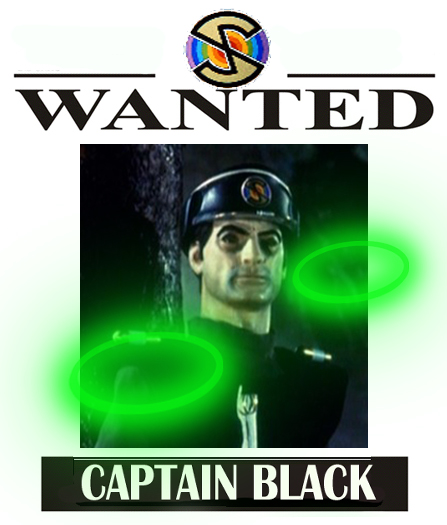
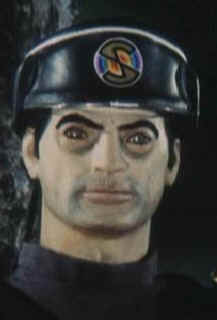
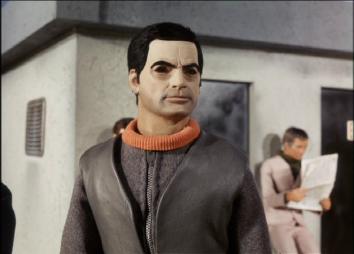
Whatever the truth, Turner’s body has been altered in some ways. His appearance is certainly different from that of any other Mysteron agent (at least as seen in the TV series, if not in some comic strips). He has a pale complexion, sunken, dark eyes, that seem inexpressive and very cold, and his chin is covered with a dark five o’clock shadow. He doesn’t speak much, but when he does, it is with the unemotional voice of the Mysterons – whereas other Mysteron agents are exact copies of the originals they were created from, in appearance and voice. Unusually, Black also acts as a conduit for ultrasonic rays and displays a phosphorescent effect when the lights go out in ‘Fire at Rig 15’, abilities that don’t appear in any other Mysteron agent.
It is not known if this power of teleportation is Black’s own, or if this is the Mysterons’ direct influence, because we are never shown another individual agent using this escape method. The only other Mysteronised agent to experience transportation is Helga, ('Model Spy') and at the time she is with Black in their getaway car. The car is removed from danger of possible capture, but the Mysteron Agents discard their human prisoner, which may suggest that the process does not work on humans. |
|||||||||||||||||||||||||
|
Captain Black in Fan Fiction
The character of Captain Black is a popular subject for authors, given that there are many unknown aspects of his life to explore and he features heavily in most Captain Scarlet fan fiction, where he is often depicted as the conduit for the Mysterons’ powers, allowing them to carry out their threats against Spectrum.
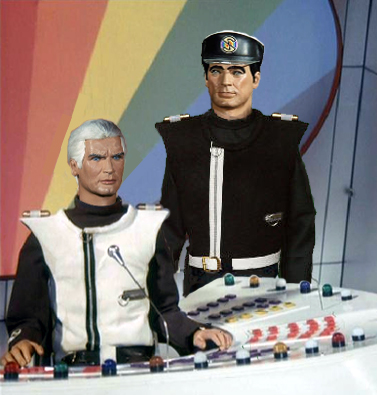
Alone amongst the captains, Black is not described by any official source as a gregarious or fun-loving personality; instead, he is depicted as something of a recluse, although there is a school of thought that depicts him and Captain Scarlet as friends – a theme that is developed and emphasised in the re-imagined ‘New Captain Scarlet’ TV series. However, in many of her stories, Marion Woods offers the idea that the two of them were not close friends, and were in competition with each other. In her short story 'The Secret', Chris Bishop presented a twist on the scenario from the pilot episode, with a ‘missing scene’ showing Captain Black present when the original Captain Scarlet was killed. Turner is also shown to be friendly with Colonel White. In Chris Bishop’s stories, it was Charles Gray himself, as a Captain in the British Fleet, who found the body of Conrad Turner, more dead than alive, floating in the ocean, thus saving his life. Some years later, Turner saves the older man’s life in return, forging a long friendship between the two of them. Various authors, in more than one story, depict Captain Black serving as second-in-command of Spectrum, and Chris Bishop, in ‘Parallax Blues’, suggested that the white belt of his uniform, as opposed to the black one worn by the other captains, was a symbol of his rank. Stories about Turner’s life before Spectrum and his Mysteronisation have been written by Matt Crowther, Keith Ansell, Tiger Jackson and Marion Woods; stories about the end of the War of Nerves or Black’s life between threats have been written by Tiger Jackson, Sue Stanhope, Clya Brown, Matt Crowther and Adrian Kleinbergen; and Halloween stories featuring Captain Black are amongst the most popular, and have been written by Keryn, amongst others. |
|||||||||||||||||||||||||
|
The many faces (and voices) of Captain Black
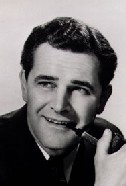
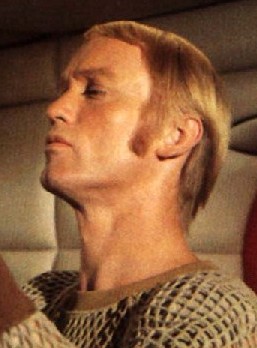
It is an accepted part of the fandom that Captain Black was originally meant to appear only in the first episode of the series, but when Gerry Anderson saw how effective his face looked after his ‘Mysteronisation’, he decided to keep him in as the Mysterons’ agent on Earth. The original voice of the human Captain Black was the British born, Canadian-based actor, Jeremy Wilkin; but, after Black had been Mysteronised, he was voiced by Donald Gray, who also did Colonel White and the Mysterons themselves. As mentioned, Black originally spoke with a North American accent, but in later episodes he had the same uninflected, emotionless voice of the Mysterons. In ‘Manhunt’, where Symphony is held prisoner by Captain Black, and in ‘Dangerous Rendezvous’, when Captain Scarlet attempts to negotiate peace with the aliens, both characters comment on ‘that voice’ – although it isn’t clear if they’re surprised to hear Black speaking with an English accent, or that the voice is the same one that issues the Mysterons’ threats. It could be that the still-human Conrad Turner is being denied the use of his voice and the only words he can speak are those of his alien controllers, but the surprising comment he makes to Symphony, (the Mysterons too have compassion) which is often thought to be a sign of his enduring humanity, is made in the same voice.
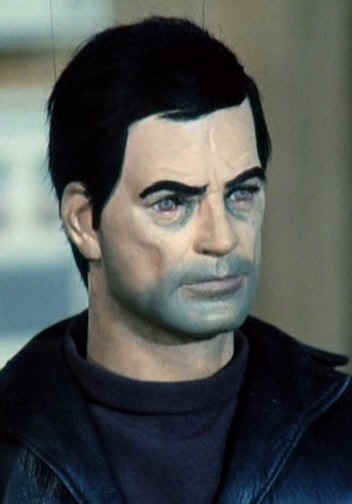
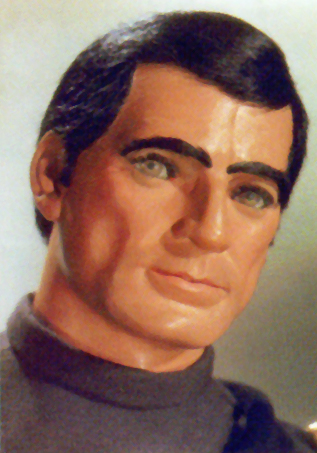
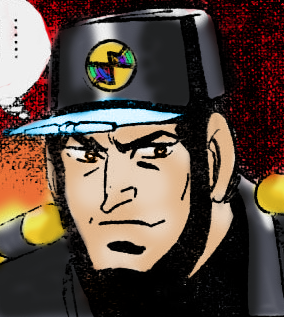
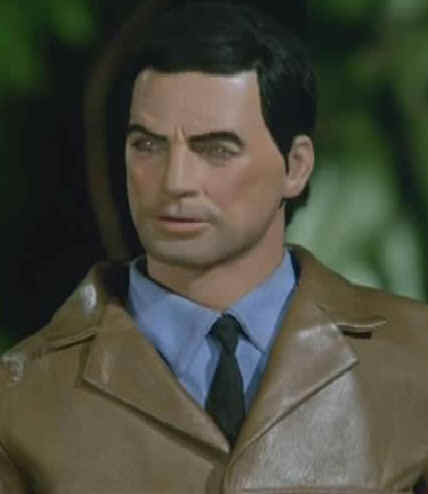
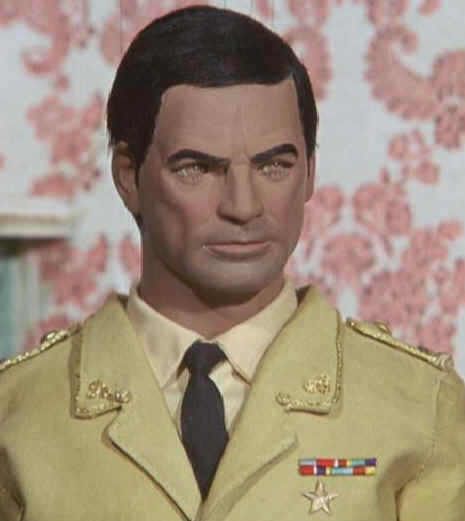
Donald Gray also reprised the role of Captain Black for the audio albums, and in ‘Captain Scarlet VS Captain Black’, the character, featured as cold and rather taciturn in the TV series performing his deeds with ruthless and unemotional indifference, takes a strange turn to become an even nastier piece of work by obviously revelling in his malevolence, while kidnapping two children. This behaviour is similar to that of the Captain Black character in the CGI series ‘New Captain Scarlet’, which was produced in 2005. The pre-Mysteronisation puppet head was a modified cast of the ‘Mysteronised’ head, with different skin tone, eyes and eyebrows, designed to highlight the change in Captain Black. The Mysteronised puppet does seem to vary in appearance, ranging from an extremely gaunt face to one that is relatively ‘human’. The Shōnen manga strip "Captain Scarlet and the Mysterons" created by Hikari Asahioka in 1968, and inspired by the TV series certainly had its fair share of odd interpretation of the original series characters. Captain Black was no exception. In the manga, the main agent of the Mysterons on Earth is sporting a beard and in an usual twist, is working undercover within the Spectrum organisation itself, and that without his colleagues knowing about it. He would be seen laying traps against his unsuspecting adversaries. |
|||||||||||||||||||||||||
|
|||||||||||||||||||||||||
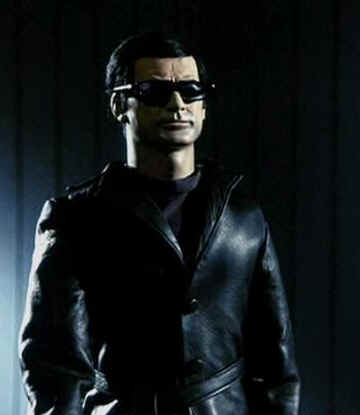
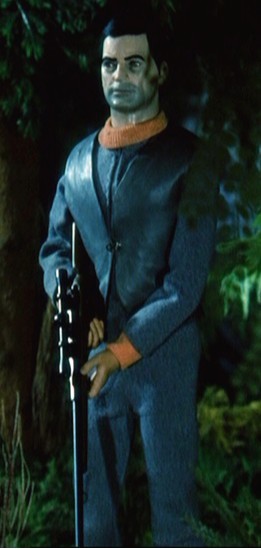
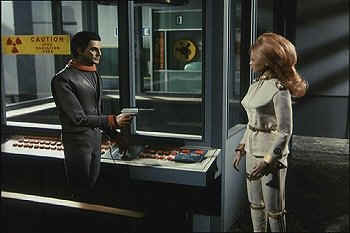
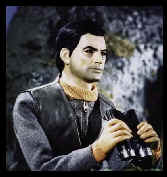
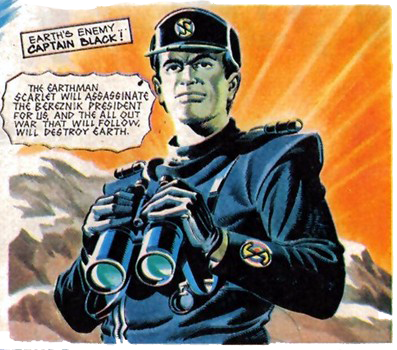
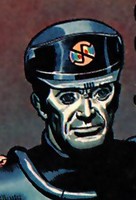
After the first episode, Black is not seen again in his Spectrum uniform (excepting flashbacks) apart from the opening credits. He wears dark clothes, such as a leather waistcoat with an orange-roll neck sweater, ('Inferno') or a black leather coat and black sweater ('Heart of New York'). However, he wears his uniform for the entire run of comic strips from the Century 21 magazine. The short run of stories drawn in 1993-1994, for the ‘Captain Scarlet magazine’, by Fleetway, shows Black in the classic civilian dark clothing he wears in most of the episodes of the TV series.
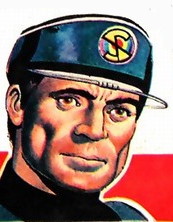
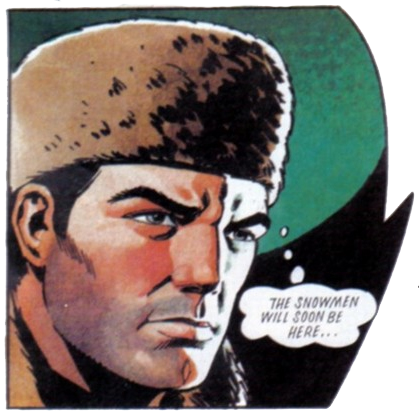
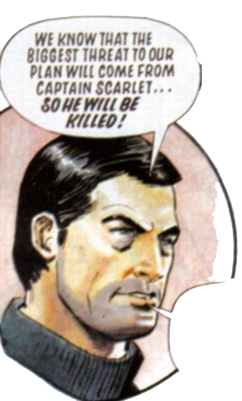
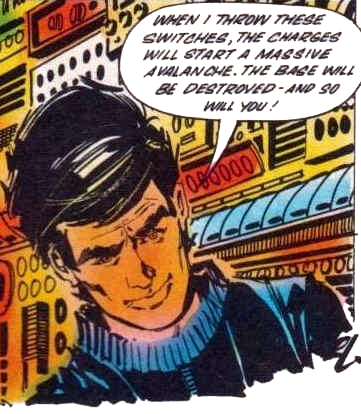
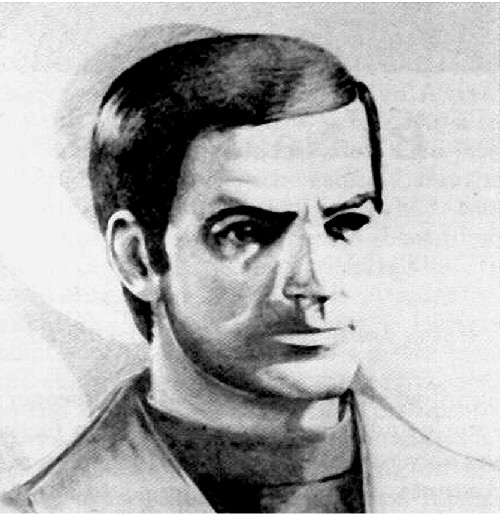
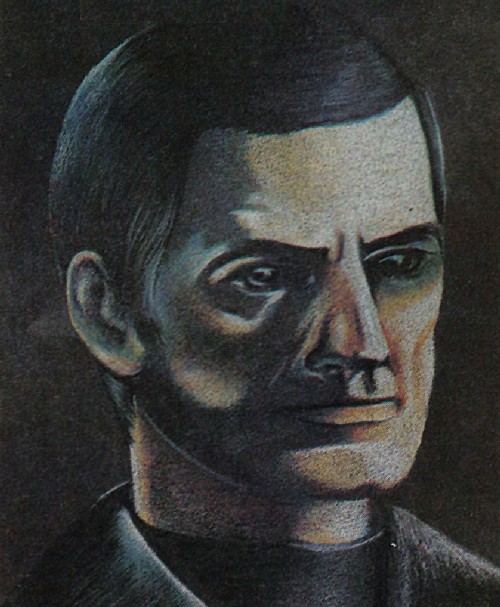
The Captain Black puppet, like most puppets from the ‘Captain Scarlet and the Mysterons' series, was re-used as guest roles in the following Supermarionation series. He appeared in ‘Joe 90’ (as General Valdes in the episode ‘Viva Cordova’) and also appeared in ‘The Secret Service’ (as Kroner, in ‘The Deadly Whisper’) and other roles. As the Mysterons’ main agent on Earth, Captain Black appeared in nearly all the 'Captain Scarlet' comic strips stories published by TV/Century 21, and in some of ‘The Angels’ strips from the 'Lady Penelope' magazine. Almost all of the artists drew the character, from Ron Embleton in the very first Captain Scarlet’s strips, to Mike Noble, Keith and Jim Watson, Barry Mitchell, Mike White and others. In the 1980s, artist Lynn Simpson drew a series of beautiful lithographs featuring characters from ‘Captain Scarlet and the Mysterons’. Captain Black was one of her chosen subjects, along with Captain Scarlet himself, Captain Blue, Colonel White and Captain Ochre. She drew a new portrait of the character, which was published in Fleetway’s ‘Captain Scarlet and the Mysterons’ magazine, in 1993-1994. |
|||||||||||||||||||||||||
|
CGI: The New Captain Black
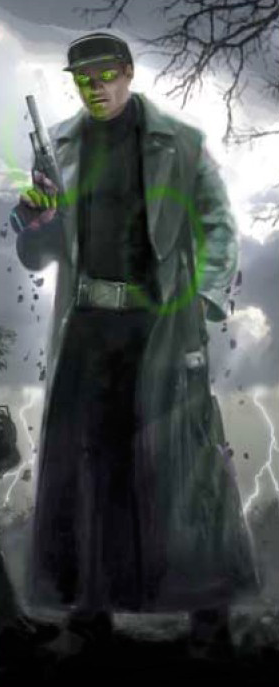
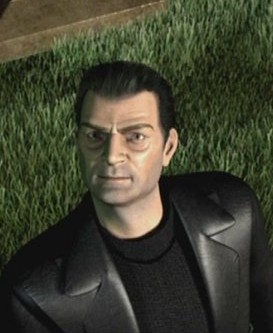
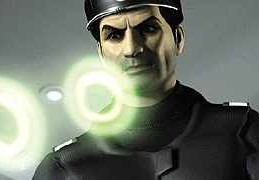
With the CGI ‘New Captain Scarlet’, it was, of course, necessary for the character of Captain Black to make a comeback. But it was to be a different Captain Black. Physically, he is quite similar to the original Black; he also kept his given name of Conrad, but his last name changed from Turner to Lefkon. His background is also different from the original Captain Black: he’s now the son of a Brooklyn crime lord, George Lefkon, who chose to join the army to escape the ‘family business’. He met Paul Metcalfe there and the two became friends, and eventually, they became members of Spectrum. In this version of the story, Black is involved in a romantic relationship with Destiny Angel, and Scarlet goes with him to Mars, where the encounter with the Mysterons occurs, but it is still Black who launches the fateful attack against the aliens. Contrary to the previous version, where there is no certainty whether Black has been Mysteronised or not, there is no doubt with the new Black, as he is obviously killed on Mars and buried on Earth after his return. It is only when the Mysteronised Scarlet fails in his mission to destroy Skybase, and is freed from Mysteron influence, that Black suddenly bursts from his grave and sets out to work for his new masters ('Instrument of Destruction'). After Black’s mysteronisation, Destiny started a relationship with Scarlet – which created a rather unusual, interesting triangle between the three characters. This new Captain Black’s characterisation is also far different from the previous incarnation. He is still cold and calculating, but he also displays a mean and cruel streak, and an evil sense of humour that echoes the characterisation Donald Gray gave to the original Captain Black in the audio-adventure ‘Captain Scarlet VS Captain Black’, and is also closer to the rendition of the same original character in the comic strips. This new Captain Black also seems to display some distorted human emotions and needs, as shown in the episode ‘Skin Deep’, where he threatens to make Destiny his own personal slave. He is quite able to play on his former allies’ feelings, manipulating them into believing he’s still the same man, in order to escape being shot at or arrested (as shown in ‘Instrument of Destruction’ among other episode). Although Nigel Plaskitt’s voice artistry for Black was perfect for the characterisation, it did not fit at all well with the official biography; if Conrad Lefkon was brought up in Brooklyn, of Greek lineage, he would probably not talk with cut-glass English accent.
As for Captain Scarlet, Captain Blue and Destiny Angel, the appearance of the CGI Black evolved during pre-production. In the 1999 AudioMotion test, Black appears as a menacing dark figure, clad in an armour-like costume (quite similar to Captain Scarlet’s). Little is seen of his features on this very short movie. Then, in 2000, in the four minute Motion Pictures Company trailer, Black appears again, as one of the three protagonists (a fourth character, Destiny, is only heard in this trailer, and not seen). Here again, Black is quite similar to the original character, wearing the Spectrum uniform, and seems to be reinstated as a Spectrum officer. His voice is performed by Gary Martin. In 2004, a publicity prospectus from Margetts and Gerry Anderson Productions gave a rather eerie rendition of Captain Black. Then, in the following year, the definite version of the new CGI character appeared in the television pilot – and changed very little in the course of the series. |
|||||||||||||||||||||||||
|
(Sources: TV Century 21 material (Annuals, books and magazines), Engale Marketing's Century 21 magazine, Issue 15, Winter 1995, Fleetway Magazines, Captain Scarlet & the Mysterons book by Chris Drake & Graham Bassett, Complete Book of Captain Scarlet by Chris Bentley… all related to TV Century 21 material - Photo-montages provided by dedicated fans.) |
CAPTAIN SCARLET - CAPTAIN BLUE - COLONEL WHITE - CAPTAIN BLACK - LIEUTENANT GREEN
CAPTAIN OCHRE - CAPTAIN MAGENTA - CAPTAIN GREY - DOCTOR FAWN
DESTINY - SYMPHONY - MELODY - RHAPSODY - HARMONY
CAPTAIN BROWN - CAPTAIN INDIGO - WORLD PRESIDENT T.J. YOUNGER
REGULAR CAST APPEARANCES - REVAMP CAST APPEARANCES - JAPANESE NAMES
You can send your comments to:
| Copyright © of all trademarked material ('Captain Scarlet and the Mysterons', and all other series titles, all their characters, vehicles, crafts, etc., Supermarionation, Century 21, CITV, and als) owned by ITV Global Entertainment/Entertainment Group Limited, a division of ITV plc. Information found on this fan site are taken from copyrighted © material (books magazines, DVDs, TV medias, comics etc.) property of their rightful owners, official organisations and/or artists depending of ownership rights (ITC/Polygram/Carlton/Anderson Ltd/GAP plc and others). This site is meant as a fan site, with respect and tribute to the work of the artists involved. No profit is made from the use of those copyrighted materials. |